
Social Signals
How to win the gatekeeper’s ‘Yes’ with stakeholder co-citation gap analysis

Jun


In Could 2025, Google introduced 25 of us right into a closed-door room at I/O to speak concerning the post-click SERP. The instruction we left with was quick: create non-commoditized content.
Right here’s the uncomfortable half:
For 15+ years, we by no means commoditized content material. We commoditized the sale. We constructed billions of pages that took a messy human drawback, focused no matter key phrase the individual compressed it into, and answered with some model of “shopping for now’s your best option.”
We did it properly for our manufacturers, and we constructed a sales-first internet.
Oops.
AI search is the invoice for that cognitive debt lastly coming due. For years, we skipped previous the customer’s actual pondering and answered “purchase now” as an alternative of their precise questions.
Paying that debt off is a hyperlink constructing drawback. Not simply hyperlinks, however the hyperlinks between sources, roles, dangers, and choices.
A co-citation hole evaluation maps these hyperlinks, exhibiting which sources AI search trusts for every purchaser function and the place your content material is lacking from the choice.
On this piece, we’ll present you methods to run it: map the sources AI search reads and cites, discover the function your content material doesn’t assist but, and build the asset that closes the gap.
Shifting from anchor textual content to anchor context
We’ve been working co-citation evaluation on the hyperlink graph for 15 years at Citation Labs.
In 2011, I printed a six-step co-citation method for link builders: discover the pages that curate a subject, depend which sources they cite collectively, and reverse-engineer what made these pages price citing.
What’s modified now’s the unit of labor: from focusing on anchor text to anchor context.

Anchor textual content instructed a search engine what a web page was about.
Anchor context tells the mannequin why that proof belongs in a particular reply, for a particular function, at a particular level within the determination.
The work strikes from describing the web page to supporting the decision.
As an alternative of asking which pages point out a subject collectively, you’re asking which sources an AI assistant trusts when every purchaser function asks about the identical determination, and which function your content material fails to assist.
That lacking determination assist is the co-citation hole.
The right way to run a co-citation hole evaluation by hand
A co-citation hole evaluation counts what AI search reads and cites throughout same-phase, same-problem prompts for various purchaser roles.
The overlaps and absences present which choices your content material doesn’t assist but.
You don’t want software program for this, only one purchaser determination, the committee round it, a set of prompts, an AI software that exhibits its work, and a spreadsheet.
1. Map the committee, and write down every function’s worry
Listing everybody who has to say sure earlier than the factor you promote will get purchased — the true deciders, not the org chart.
For instance, for a funded biotech that’s selecting a emblem, the committee is the CEO, in-house counsel, ops, and advertising.
Subsequent to every, write what that person is afraid of. That worry is the query they’ll carry to an assistant, so write it in first individual:
- CEO: Will we appear to be a severe, fundable firm?
- Counsel: Is that this identify or mark going to get us sued or compelled to rebrand?
- Ops: Will this survive manufacturing (from a favicon to signage to a 96-well plate label)?
- Advertising: Will this carry out (get acknowledged, stand out chilly to buyers and recruits)?
4 roles, 4 fears, one determination.
Word: Solo purchases work the identical approach. The “committee” is one purchaser’s competing considerations. The unit isn’t the committee, it’s the choice point.
2. Write one immediate per function
Create one managed immediate per function, all based mostly on the identical shopping for determination. Hold the state of affairs fastened and alter solely the function. That makes the function’s area of apply the variable.
Comply with these 5 guidelines:
- One shared state of affairs. Hold the scenario fastened; change solely who’s asking.
- First individual, within the function’s voice. Mannequin their phrases, worries, and perspective.
- Put the function in a particular scenario. Generic prompts get generic solutions. Particular conditions set off retrieval, and retrieval is the information.
- Bundle the function’s actual considerations. Actual deciders carry a cluster, not one tidy query.
- Identify no manufacturers. Model names pollute the quotation set.
Right here’s the CEO immediate from our “make a emblem” instance:
“I’m the founder-CEO of a biotech that closed a Sequence A, briefing a design agency on a brand new emblem. I desire a viewpoint to indicate them, not a clean web page. What do credible, well-funded biotech manufacturers share visually? Which startups nailed a post-raise rebrand? Which botched it? What do buyers and pharma companions learn right into a younger model? What ought to a non-designer like me use to tough out a number of choices?”
Then add one kill-switch immediate per function: “What’s the one factor right here that, if we get it fallacious, we are able to’t undo? What would make me say no?”
This surfaces the exhausting veto function.
Run a couple of phrasing. The sign is what repeats, not what seems as soon as.
3. Seize what the assistant searches, reads, and cites
Use an assistant that exposes its sources. For every function’s run, open the exercise or sources panel and duplicate three fields into your spreadsheet:
- Sub-queries generated
- Pages learn
- Pages cited
Tag every learn web page by kind as you go:
- Discussion board/hub (Reddit, aggregators, and so forth.)
- Main/official (a regulator, a requirements physique, and so forth.)
- Vendor (companies and options)
The combination exhibits what sort of proof every function trusts.
In our instance, practically a 3rd of all the things learn was Reddit, and over 40% was high-volume hubs.
Your pages will kind into three states:
- If it’s learn and cited, it was consulted and used.
- If it’s learn however not cited, it was consulted however dropped. That’s a content material drawback.
- If it’s not learn, it was by no means consulted. That’s a discoverability drawback.
The dropped-but-read pages are the place the most affordable wins cover.
4. Construct the quotation matrix
Now, flip your kind listing right into a matrix — that is the co-citation evaluation.
Make one row per distinctive cited URL, one column per function, and one depend column exhibiting what number of roles cited it.
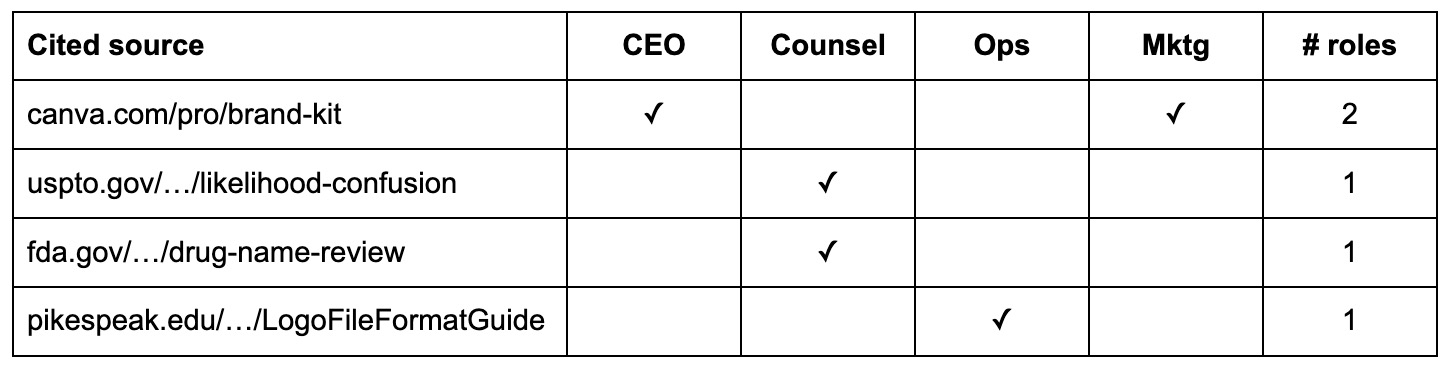
Word: One row per cited URL
Right here’s what the matrix appeared like in our “make a emblem” instance:
Kind by depend. You’ll see which sources are shared, that are role-exclusive, and which roles have nearly no overlap.
5. Discover the function with the veto energy
With the matrix sorted, search for three constructions.
The shared core is all the things cited by 2+ roles. If it’s practically empty, the committee is disjointed (you serve it seat by seat). If it’s substantial, the committee is convergent (you win the commons and the gatekeeper).
An remoted decider is a decisive function whose cited sources are largely role-exclusive. An empty edge is 2 must-agree roles that share nothing.
Then set precedence: whose “no” is remaining, and whose sources overlap least with everybody else’s?
That’s your veto × isolate seat. Construct content material there first.
Seize this in a spreadsheet you may replace and rerun:

6. Add the part axis
Run the evaluation once more, however transfer the identical determination ahead in time. Hold every function the identical whereas altering the state of affairs:
Selecting → Rolling Out → Getting Worth and Renewing
The cited set shifts at each stage whereas the proprietor of the reply palms off as the customer strikes.
Word the place you’re current in a single stage however lacking in others.
These gaps are asset targets.
7. Create a content material and outreach plan
Your matrix offers you a prioritized content material technique:
- Gatekeeper: The veto-isolate seat, decisive and unserved.
- Empty edges: The place two must-agree roles share nothing.
- Shared core: Sources cited by a number of roles.
- Part gaps: Phases the place your model seems, then disappears, by function.
The brand new work is placement, and the mannequin already instructed you the place. The sub-queries present the domains it trusts for every function.
In our instance, the CEO run ran web site:businesswire.com, web site:fiercebiotech.com, and web site:prnewswire.com; the ops run ran web site:builders.google.com/search/docs
Almost each function appended “official” to chase major sources.
That’s your placement and outreach listing — written by the AI assistant. Earn your proof on the surfaces it already uses when answering that function.
And keep in mind the unit you’re constructing in: anchor context, not anchor textual content.
The asset’s job isn’t to indicate a well-liked possibility. It exhibits: who this helps, what it solves, when it matches, and why it belongs — for this function, at this selection level.
8. Measure the affect
Lock your immediate set and rerun it in a number of weeks. (We’ve seen results in less than 3 weeks with our shoppers.)
Rebuild the cited column and examine it to the baseline. Search for three actions: your brand appears where it didn’t before, positioned sources enter the gatekeeper’s reply, or an empty edge begins to fill.
It’s tedious by hand, however the loop is at all times the identical: baseline, construct, re-run, examine.
The cited set is the scoreboard.
If you happen to’d like a sooner technique to run this, reach out to Citation Labs. We’ll share our immediate stack with you.
The right way to flip the matrix into choices
As soon as the matrix is sorted, evaluate the form of the quotation set.
If a number of sources are cited by a lot of the committee, it’s convergent. There’s shared floor to win. If the highest is sort of naked, it’s disjointed. Each function is in its personal world, and generic “backside of funnel” content material received’t carry the choice.
In our make-a-logo instance, precisely one supply was cited by a number of roles: Canva’s brand-kit web page. On the learn degree, Reddit, Wikipedia, and arXiv confirmed up throughout roles, however nearly none of that survived into what obtained cited.
Now discover the seat that shares nearly nothing with anybody.
That’s the hole.
In our instance run, it was Counsel: 14 cited sources, none shared with one other function, all from authorized, regulatory, and trademark sources.
Lowest competitors on the map. Highest leverage.
You might also discover an empty edge: two roles that each need to say sure however cite nothing in frequent. Their standards collide with no content material in between. Every empty edge is a bridge asset ready to be constructed.
Don’t be stunned by who the gatekeeper is. Within the committees we’ve mapped up to now, the veto-isolate has constantly been compliance, safety, or authorized. The org chart underweights them, however the quotation map doesn’t. It exhibits the seat that may cease the choice and has the least content material assist.
That’s the place you construct first.
Then test the part re-run. Once you transfer the committee from selecting to rolling out to getting worth, the quotation set shifts. Most manufacturers concentrate on “selecting” and ignore all the things after.
Additionally, the choice doesn’t finish on the sale. It runs by means of rollout, adoption, renewal, and the following inside justification.
The transfer that pays is to tug the late “no” upstream, so the veto lands as a redirect moderately than a demolition.
For our emblem committee, “gatekeeper first” turned a Founder’s Preliminary Trademark Clearance Temporary: a one-page temporary the founder fills out earlier than Counsel critiques a reputation or mark. It captures proposed property, industrial context, preliminary checks, and particular questions for Counsel.
Watch what that single web page does:
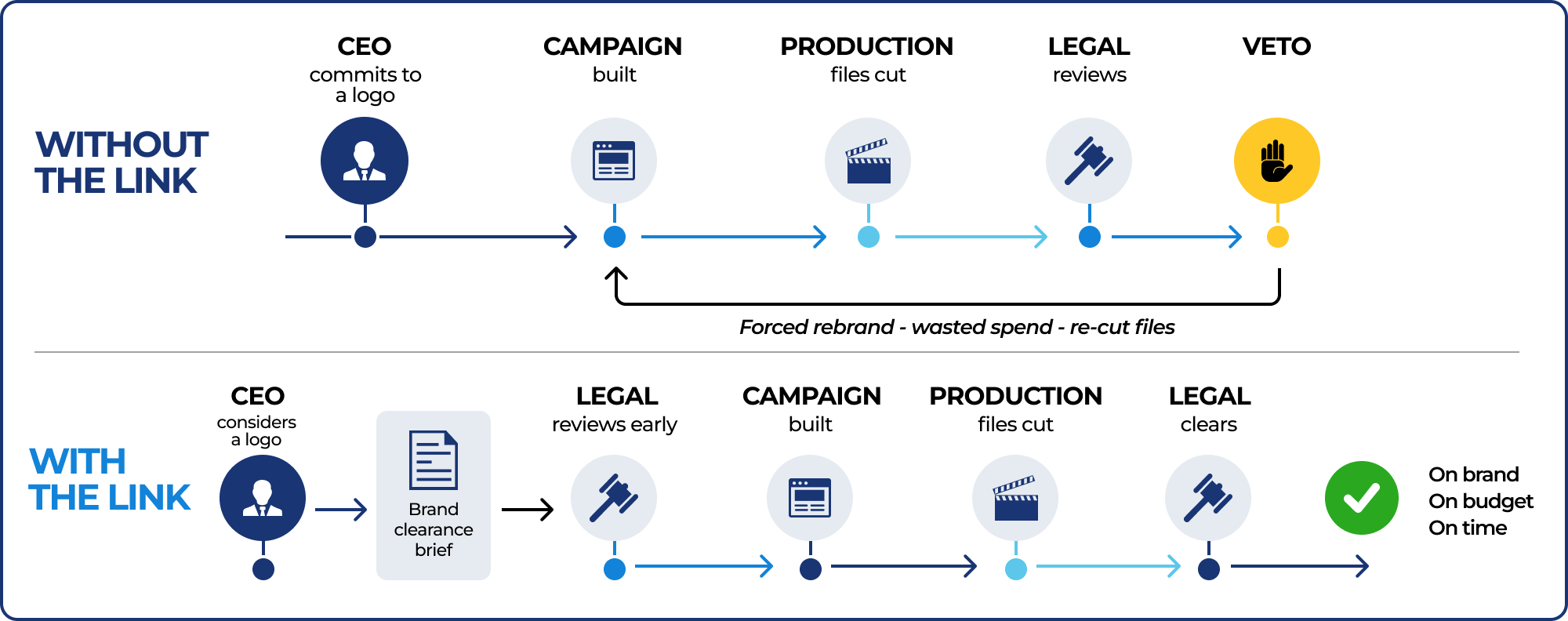
It offers the CEO one thing Counsel can evaluate earlier than the work goes too far. The veto surfaces earlier than cash will get spent. And either side keep away from the silent standoff: “Why do they hold blocking this?” versus “FFS, did they even test?”
The temporary makes them test (in a kind that Counsel can act on) earlier than both of them will get offended.
That’s anchor textual content changing into anchor context: “right here’s precisely what this decider wants, for the time being they want it, within the kind that lets them say sure.”
That is the work for hyperlink builders
For 15 years, we built links at Citation Labs.
The nice ones have been about placing the proper proof in entrance of the proper individual for the time being they needed to decide.
AI search didn’t finish that work. It clarified it.
Construct greater than hyperlinks. Construct the hyperlinks between selection factors: the places where you reduce effort, uncertainty, and the danger of being misinterpret.
Begin with the seat that may say no and that nobody is writing for.
That’s the gatekeeper. That’s the hole.
That’s the work.
Opinions expressed on this article are these of the sponsor. Search Engine Land neither confirms nor disputes any of the conclusions introduced above.
#win #gatekeepers #stakeholder #cocitation #hole #evaluation
