
Social Signals
How to build an AI-powered content gap analysis workflow

Jul

You possibly can publish persistently, observe web optimization greatest practices, and nonetheless watch opponents outrank you. Most of the time, the issue isn’t content material high quality. It’s content material protection. Your opponents are answering questions your viewers is asking, and also you’re not within the dialog but.
That’s the place a content material hole evaluation is available in. It helps you establish subjects your opponents rank for that you simply don’t, then resolve which alternatives are literally value pursuing.
Discovering the gaps isn’t the exhausting half. web optimization instruments make that straightforward. The problem is making sense of 1000’s of key phrases unfold throughout a number of stories and deciding what deserves your consideration first.
This workflow exhibits learn how to mix competitor information, first-party search information, and AI to prioritize content material alternatives and construct a roadmap primarily based on enterprise influence, not simply search quantity.
Convey your web optimization information collectively earlier than you analyze it
On this workflow, I exploit Semrush to establish aggressive alternatives, Google Search Console to validate the place my web site is already exhibiting indicators of authority, and Google Analytics so as to add enterprise context. Claude then brings these datasets collectively, grouping associated alternatives, figuring out patterns, and serving to prioritize what belongs on the content material roadmap.
There are two methods to observe this course of:
- You possibly can export stories immediately from the platforms and add them to Claude.
- Or, in case you’ve linked these platforms by way of MCP (Mannequin Context Protocol, a regular that enables AI fashions to attach securely to your information sources), Claude can pull the info immediately with out handbook exports. The workflow modifications, however the evaluation doesn’t.
Beneath, I’ll stroll by way of the method I exploit to show a pile of web optimization information right into a prioritized content material plan.
Step 1: Select the correct opponents
A content material hole evaluation is barely pretty much as good because the opponents you examine your self towards. That sounds apparent, but it surely’s one of many best errors to make.
When you examine your web site to Amazon, Reddit, or Wikipedia, you’ll find yourself with 1000’s of key phrase “alternatives” that had been by no means real looking to start with. The purpose isn’t to search out each web site rating in your goal key phrases. It’s to search out companies competing for a similar viewers.
I sometimes begin with Semrush’s Natural Rivals report. Quite than counting on an inventory of identified opponents, this report identifies domains competing for most of the identical key phrases. From there, I slim the listing to a few to 5 websites that carefully match your small business and target market.
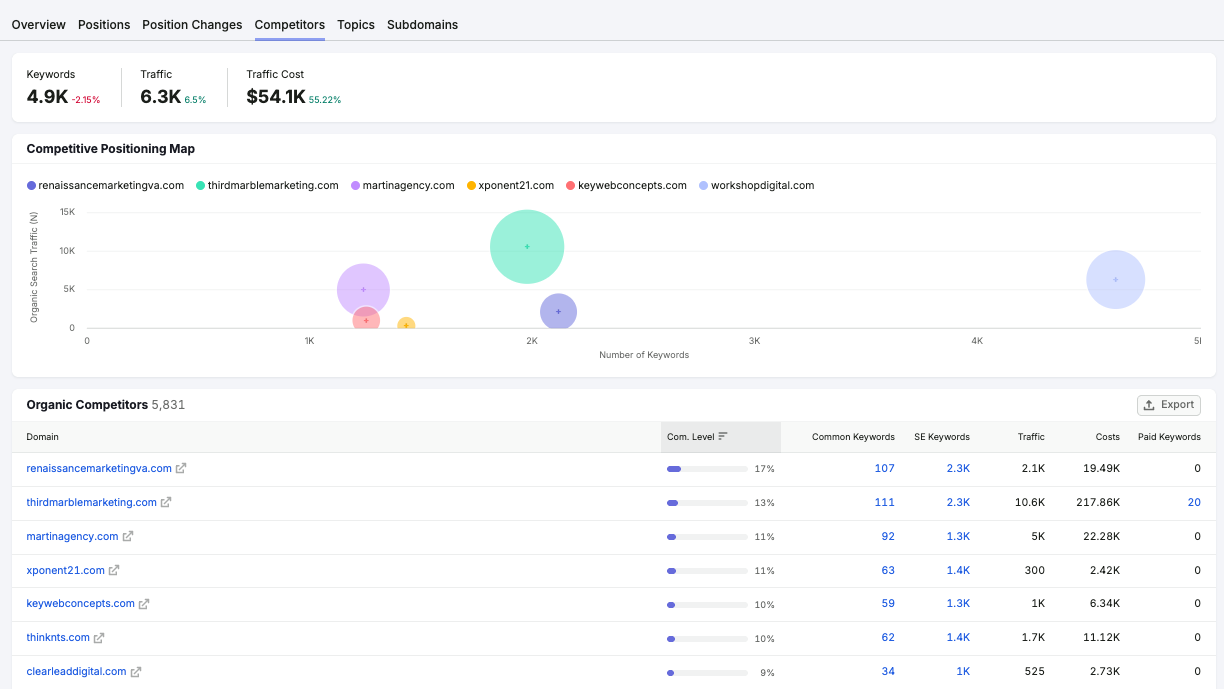
Don’t be shocked if a number of acquainted names don’t make the reduce. Enterprise opponents and natural search opponents aren’t all the time the identical.
You also needs to filter out websites that can skew the evaluation, together with:
- Giant marketplaces like Amazon
- Neighborhood-driven websites like Reddit or Quora
- Reference websites like Wikipedia
- Native directories or evaluate websites
- Publishers that don’t immediately compete with your small business
There are exceptions. When you’re a writer, evaluating your self towards different editorial websites makes excellent sense. The bottom line is selecting opponents that create the kind of content material you’re realistically attempting to outperform.
Lastly, sanity-check the listing with stakeholders. Your gross sales or product groups could level out opponents that don’t seem in Semrush as a result of they’re newer or competing in a strategically essential area of interest.
When you’ve settled in your opponents, you’re prepared to search out the gaps that matter most.
Be the brand AI recommends.
See where your brand appears in AI search, where competitors are winning, and what it takes to become the answer AI recommends.
See your AI visibility
Step 2: Collect and put together your information
Together with your competitor listing finalized, it’s time to gather the info Claude will analyze. Whether or not you’re importing exports or connecting by way of MCP, the purpose is similar: convey collectively aggressive rankings, your web site’s search efficiency, and engagement information so you’ll be able to separate significant alternatives from noisy key phrase lists.
I like to tug information from three sources.
Semrush: Discover the gaps
Begin with Semrush’s Key phrase Hole device utilizing the opponents you chose in Step 1.

Pay shut consideration to a few buckets:
- Rivals rank, you don’t. These are your greatest content material alternatives and sometimes level to lacking subjects or content material hubs.
- You rank, however opponents rank greater. Concentrate on key phrases the place you’re already on Web page 1 or 2. These are sometimes faster wins as a result of Google already associates your web site with the subject.
- You rank, opponents don’t. These are your strengths. Don’t ignore them. They spotlight subjects the place you have already got a bonus and may proceed investing.
Google Search Console: Validate the chance
Subsequent, examine Google Search Console earlier than assuming each lacking key phrase deserves a brand new web page.
For instance, Semrush could present that you simply don’t rank for a specific key phrase, however GSC might reveal that you simply’re already receiving impressions for carefully associated queries. That tells you Google has began associating your web site with the subject, even when rankings haven’t caught up but.
These “virtually there” subjects usually deserve the next precedence than ranging from scratch.
Search for:
- Queries with excessive impressions however common positions between 8 and 20.
- Present pages rating for associated phrases.
- Lengthy-tail queries that reveal extra search intent.
Google Analytics: Add enterprise context
Search quantity is barely a part of the story. Engagement metrics assist reply an equally essential query: When you enhance visibility for this matter, is it more likely to assist your small business objectives?
Overview metrics similar to:
- Natural classes.
- Engagement price.
- Common engagement time.
- Key occasions or conversions.
- Touchdown web page efficiency.
If a associated content material hub already drives engaged guests or conversions, increasing that matter could also be a wiser funding than chasing a very new key phrase with greater search quantity.
Clear your information earlier than handing it over to Claude
When you’re manually downloading the info and importing it to Claude, I like to recommend cleansing it first. Claude is superb at discovering patterns, however it may possibly solely work with the info you give it. A cleaner dataset results in cleaner matter clusters and higher suggestions.
Take away:
- Duplicate key phrases.
- Competitor-branded phrases.
- Careers, login, and assist queries.
- Areas or product strains outdoors your small business.
- Key phrases with clearly totally different search intent.
- Excessive-intent business key phrases which can be too broad to compete for. (For instance, generic trade phrases that don’t match your small business mannequin.)
Two methods to collect your information:
- Handbook workflow: Export Key phrase Hole information from Semrush, together with question information from Google Search Console and touchdown web page efficiency information from Google Analytics, then add the recordsdata to Claude.
- Linked workflow (MCP): Ask Claude to retrieve the Key phrase Hole report, GSC question information, and GA4 touchdown web page metrics immediately out of your linked accounts. You possibly can then transfer straight into the evaluation with out downloading CSVs.
Step 3: Ask Claude to search out the story in your information
At this level, you need to have a clear dataset that mixes aggressive key phrase gaps, Search Console efficiency, and Google Analytics information.
Now comes the enjoyable half.
As a substitute of scrolling by way of 1000’s of rows on the lookout for patterns, ask Claude to arrange the info into one thing you’ll be able to truly construct a method round.
The error I see most frequently is asking AI to “cluster these key phrases.”
You’ll definitely get clusters again, however they’ll normally be primarily based on key phrase similarity alone. That’s helpful, but it surely doesn’t inform you what to do subsequent. As a substitute, ask Claude to suppose like an web optimization strategist.
Present context about your small business, together with:
- Your services or products
- Your target market
- Your main enterprise objectives
- Any content material priorities or constraints
- The exported stories or linked information from Semrush, GSC, and Google Analytics
Then ask Claude to arrange alternatives by elements similar to:
- Search intent
- Funnel stage
- Enterprise relevance
- Present authority alerts from GSC
- Consumer engagement from GA4
- Really useful content material format
- Inside linking alternatives
Quite than returning a spreadsheet of grouped key phrases, Claude ought to produce matter clusters with a transparent suggestion for every one. I’ve offered an instance beneath.

For instance, one cluster is likely to be labeled Technical web optimization Audits and embody:
- Supporting key phrases.
- Estimated alternative.
- Present pages that could possibly be up to date.
- Whether or not a brand new web page is required.
- Inside linking suggestions.
- Precedence rating.
- Reasoning behind the advice.
One other cluster may reveal that a number of competitor key phrases may be addressed by increasing an present information as a substitute of publishing three separate articles. That’s the form of perception that’s troublesome to identify manually however straightforward for AI to floor.
Separate fast wins from long-term investments
Not each alternative belongs on the identical roadmap. As a part of your immediate, ask Claude to categorise every cluster into classes similar to:
- Fast wins: Present pages that may be refreshed, expanded, or higher optimized.
- New content material alternatives: Subjects that deserve devoted content material as a result of you’ve little or no visibility.
- Authority performs: Bigger topic areas which will require a number of items of content material and ongoing funding to compete successfully.
This straightforward step helps you progress from an amazing key phrase listing to a roadmap with each short-term wins and long-term initiatives.
Don’t skip the human evaluate
Claude can set up info remarkably properly, but it surely doesn’t know your small business the way in which you do.
Earlier than shifting on, ask questions similar to:
- Does this matter assist our enterprise objectives?
- Are a number of search intents being mixed into one cluster?
- Will we have already got content material that would fulfill this want?
- Is that this a sensible alternative given our authority and assets?
- Would I truly assign this matter to a author?
If the reply is “no,” refine the cluster or take away it.
The purpose isn’t to just accept each suggestion. It’s to spend much less time organizing information and extra time making strategic selections.
Immediate template: I’ll share the total immediate I exploit on the finish of this text, however the greatest takeaway is that this: Don’t ask Claude to arrange key phrases. Ask it to advocate what your content material technique ought to be primarily based on the info you’ve offered.
Get the e-newsletter search entrepreneurs depend on.
Step 4: Rating and prioritize the alternatives
As soon as Claude has grouped your key phrases into matter clusters, the following step is deciding what deserves your consideration first.
That is the place many content material hole analyses disintegrate. Groups naturally gravitate towards the largest search volumes, however quantity is just one piece of the puzzle. A subject that draws certified guests and helps your small business objectives is usually a greater funding than a high-volume key phrase that’s troublesome to rank for or unlikely to transform.
I like to attain every alternative throughout a number of standards earlier than constructing a roadmap.
Enterprise relevance
Begin by asking a easy query: If this content material performs properly, does it assist the enterprise?
Subjects that align together with your merchandise, companies, or buyer journey ought to obtain extra weight than informational subjects with little business worth.
Present authority
Subsequent, have a look at the alerts from Google Search Console.
In case your web site already earns impressions or ranks on the second web page for associated queries, Google has seemingly established some degree of topical authority. Bettering an present web page or increasing a content material hub could produce outcomes a lot quicker than ranging from scratch.
Search demand
Search quantity issues, but it surely shouldn’t dominate the scoring mannequin.
A set of associated long-tail queries with reasonable demand can typically generate extra certified visitors than a single broad key phrase.
Rating issue
Overview the present search outcomes earlier than committing to a subject.
Ask questions similar to:
- Are authoritative manufacturers dominating the primary web page?
- Is the intent primarily informational, business, or transactional?
- What forms of content material are rating?
- Are you able to realistically create one thing extra helpful or full?
This fast actuality examine can save your workforce from chasing alternatives that aren’t sensible.
Estimated effort
Lastly, think about the work concerned. Some alternatives require a lightweight refresh of an present article. Others name for a brand new content material hub supported by a number of pages.
Each may be worthwhile, however they shouldn’t carry the identical precedence if assets are restricted.
Let Claude apply the framework
When you’ve outlined your scoring standards, Claude can consider each matter cluster persistently.
For instance, you may ask Claude to attain every alternative on a five-point scale for:
- Enterprise relevance.
- Present authority.
- Search demand.
- Rating issue.
- Content material effort.
Then have it calculate an general precedence rating and clarify why every suggestion obtained that rating. The reason is simply as beneficial because the quantity. When you disagree with a suggestion, you’ll be able to alter the weighting, add extra enterprise context, and ask Claude to attain the alternatives once more.
By the tip of this step, you need to have greater than an inventory of content material concepts. You must have a prioritized content material technique that clearly identifies what to deal with subsequent, what can wait, and what isn’t value pursuing. I’ve offered an instance of Claude’s output beneath.

Step 5: Flip priorities into page-level suggestions
When you’ve prioritized your alternatives, the following step is determining precisely what to vary.
Quite than handing your workforce a ranked listing of subjects, ask Claude to generate page-level suggestions in your highest-priority alternatives. That is the place linked information turns into particularly beneficial.
As a result of Claude has entry to your Semrush analysis, Google Search Console efficiency, Google Analytics metrics, and your prioritization framework, it may possibly consider every web page in context as a substitute of treating each suggestion the identical.
For every precedence web page, I ask Claude to provide a suggestion that features:
- Why the web page was chosen.
- The first key phrase cluster.
- Present rankings and impression information.
- Supporting proof from GSC and competitor analysis.
- Really useful updates.
- Estimated effort.
- Anticipated influence.
- Precedence degree.
One of many greatest benefits of this method is validation.
Earlier than recommending a refresh, Claude can examine URL-level Search Console information towards the unique evaluation. Typically what appears like an ideal alternative seems to be deceptive. A key phrase could have inflated impression counts, a URL might have been mislabeled in an export, or the web page merely isn’t as near rating because it first appeared.
Catching these points earlier than assigning work can save hours of pointless effort.
The suggestions additionally make conversations with stakeholders a lot simpler. As a substitute of claiming, “We should always replace this web page,” you’ll be able to level to the supporting information, clarify why it’s a precedence, estimate the hassle concerned, and tie the advice again to your general content material technique.
Consider these suggestions as implementation plans relatively than content material briefs. They’re designed to assist your web optimization and content material groups perceive what ought to change, why it issues, and the place to focus first. Writers can then use these suggestions to create or replace content material with confidence.
Beneath is an instance of a page-level refresh transient generated by Claude.

Step 6: Measure whether or not the hole is closing
Publishing your content material isn’t the end line. It’s the beginning of the following spherical of study.
I start with Google Search Console, monitoring whether or not goal queries are gaining impressions, bettering in common place, and producing extra clicks. Once I refresh an present web page, I examine efficiency earlier than and after the replace to see whether or not the modifications truly moved the needle.
Subsequent, I have a look at Google Analytics. Higher rankings don’t all the time translate into higher enterprise outcomes, so I evaluate natural visitors alongside engagement and conversion metrics. If an up to date web page attracts extra guests however fails to maintain them engaged or contribute to conversions, it’s most likely time for one more spherical of optimization.
When you’re utilizing Claude by way of MCP, you may as well ask it to match efficiency over time and summarize what modified. For instance:
- Which refreshed pages improved essentially the most?
- Which content material clusters gained essentially the most visibility?
- Which suggestions drove the strongest enterprise outcomes?
- Which alternatives nonetheless want consideration?
As a substitute of evaluating stories month after month, Claude can rapidly floor vital modifications and level you towards the pages that deserve your consideration.
Lastly, don’t deal with content material hole evaluation as a one-time train. Rivals publish new content material, search habits shifts, and your individual authority evolves. I like to recommend repeating this workflow each quarter, or extra usually in fast-moving industries, to search out new alternatives and keep forward of your competitors.
The instruments will proceed to advance, however a repeatable workflow is what creates the benefit.
Construct a repeatable content material hole evaluation course of
A content material hole evaluation helps you prioritize the alternatives value pursuing as a substitute of chasing each potential key phrase.
Semrush helps uncover aggressive gaps. Google Search Console exhibits the place you have already got momentum. Google Analytics provides the enterprise context that rankings alone can’t present. Claude brings these datasets collectively, serving to you establish patterns, prioritize alternatives, and create actionable suggestions in a fraction of the time it will take manually.
Whether or not you add stories or join your instruments by way of MCP, the workflow stays the identical. Collect the correct information, validate the alternatives, let AI set up the knowledge, and apply your individual experience to resolve what comes subsequent. That’s the half AI can’t substitute.
The most important benefit isn’t having higher prompts or quicker evaluation. It’s having a repeatable course of that helps your workforce make smarter content material selections each quarter.
Immediate template: Construct a prioritized content material hole roadmap
Right here’s the immediate I promised. Use it after you’ve gathered your information, whether or not you’ve uploaded exports from Semrush, Google Search Console, and Google Analytics or linked these instruments to Claude by way of MCP.
“You’re an skilled web optimization strategist serving to me carry out a content material hole evaluation.
I’ll both present exported stories from Semrush, Google Search Console, and Google Analytics, otherwise you’ll entry these instruments by way of linked MCP integrations.
My purpose is to establish the highest-impact content material alternatives primarily based on competitor visibility, present authority, enterprise worth, and implementation effort.
Right here’s my enterprise context:
– Firm:
– Trade:
– Merchandise/companies:
– Audience:
– Major enterprise objectives:
– Geographic focus:
– Any strategic priorities or constraints:
– Tone of voice: [Insert brand voice adjectives here (e.g., authoritative, conversational, technical)].Utilizing the obtainable information, full the next duties.
1. Establish content material gaps
Manage key phrases into these classes:
– Rivals rank and we don’t.
– We rank beneath opponents.
– We rank and opponents don’t.Spotlight any content material gaps, alternatives to consolidate pages, or key phrase cannibalization points.
2. Validate the alternatives
Use Google Search Console information to find out:
– Which subjects already obtain impressions.
– Which pages rank between positions 8 and 20.
– Which present URLs have the strongest probability of bettering with optimization.Use Google Analytics information to find out:
– Which pages drive significant engagement.
– Which pages contribute to conversions.
– Which content material hubs are value increasing.3. Create strategic matter clusters
Group associated alternatives by:
– Search intent
– Enterprise relevance
– Funnel stage
– Really useful content material kind
– Inside linking alternativesDon’t cluster primarily based solely on key phrase similarity. Concentrate on subjects that ought to turn into a part of the identical content material technique.
4. Prioritize each alternative
Rating every matter cluster utilizing:
– Enterprise relevance
– Present authority
– Search demand
– Rating issue
– Estimated effortAssign every alternative a precedence (Excessive, Medium, Low) and clarify why.
Separate suggestions into:
– Fast wins
– New content material alternatives
– Lengthy-term authority investments5. Advocate subsequent steps
For each high-priority alternative, advocate whether or not we should always:
– Refresh an present web page
– Consolidate a number of pages
– Create a brand new web page
– Construct a pillar web page with supporting content materialEmbody supporting proof for each suggestion.
6. Ship the outcomes
Create:
– An government abstract
– Prioritized matter clusters
– A scored alternative desk
– Web page-level suggestions for the highest-priority URLs
– A phased implementation roadmap (30, 60, and 90+ days)When you discover conflicting information between Semrush, Google Search Console, and Google Analytics, clarify the discrepancy and advocate which supply ought to information the choice. The output ought to each be HTML and a Google Sheet.
Earlier than presenting your closing suggestions, validate your individual evaluation. If reviewing Search Console or Analytics information modifications your unique suggestion, clarify why and replace your prioritization accordingly.”
This immediate is a place to begin. Add any enterprise context, editorial pointers, or scoring standards which can be distinctive to your group. The extra context you give Claude, the extra helpful and actionable its suggestions might be.
Contributing authors are invited to create content material for Search Engine Land and are chosen for his or her experience and contribution to the search group. Our contributors work beneath the oversight of the editorial staff and contributions are checked for high quality and relevance to our readers. Search Engine Land is owned by Semrush. Contributor was not requested to make any direct or oblique mentions of Semrush. The opinions they categorical are their very own.
#construct #AIpowered #content material #hole #evaluation #workflow
