
Social Signals
Attribution vs. incrementality: Why you need both

Jul

Incrementality and attribution are two approaches to measuring advertising efficiency which might be ceaselessly mentioned as if they’re competing lenses viewing the identical knowledge. However they’re truly designed to reply very totally different questions, utilizing totally different types of proof.
Attribution asks which noticed advertising touchpoints ought to obtain credit score for a conversion. Incrementality asks whether or not the advertising exercise triggered further conversions that wouldn’t have occurred with out it.
A refresher on attribution
Attribution is the favored little one of selling analytics groups in all places, circa 2015. Entrepreneurs found that some conversion paths contained a number of touchpoints throughout the digital panorama, like this:
- Show → Paid Social → Natural Search → E-mail → Buy.
That raised questions on which channel ought to get what “credit score”:
- Ought to the show advert get probably the most credit score for the conversion as a result of it was the primary publicity?
- Or ought to the e-mail, as a result of that’s the touchpoint that lastly satisfied the consumer to purchase?
- And what concerning the social advert and the natural presence within the center?
That’s the place attribution modeling got here in. Attribution modeling offered frameworks for deciding how that credit score needs to be distributed. Some fashions assigned your entire conversion to a single touchpoint. Others divided it amongst a number of interactions.
So if the ultimate worth of the conversion is $100, an attribution mannequin tells entrepreneurs that show can take credit score for $30, e mail for $30, and the remaining $40 is break up between paid social and natural.
Then, once you’re evaluating the success of your channels, you’ve gotten a extra nuanced framework for distributing income credit score. And once you’re deciding on what channels get what funds for the subsequent fiscal 12 months, you’ve gotten a technique to evaluate and distinction.
Instance: How a $100 conversion is likely to be distributed throughout 4 advertising touchpoints.
| Attribution mannequin | Show | Paid Social | Natural Search | How credit score is assigned | |
| First-touch | $100 | $0 | $0 | $0 | All credit score goes to the primary noticed interplay. |
| Final-touch | $0 | $0 | $0 | $100 | All credit score goes to the ultimate noticed interplay earlier than buy. |
| Linear | $25 | $25 | $25 | $25 | Credit score is split equally amongst each noticed touchpoint. |
| Place- based mostly | $40 | $10 | $10 | $40 | The primary and final interactions obtain probably the most credit score, whereas the center interactions break up the rest. |
| Time-decay | $10 | $20 | $30 | $40 | Touchpoints obtain progressively extra credit score as they happen nearer to the conversion. |
| Knowledge-driven | $30 | $20 | $20 | $30 | Credit score is distributed in line with every touchpoint’s estimated contribution to the conversion. |
Observe: These are simplified examples. Place-based fashions can use totally different weighting guidelines, time-decay allocations rely on timing, and precise data-driven fashions differ.
See exactly how your competitors win.
Uncover the keywords, ads, landing pages, and strategies driving your competitors’ paid search success—and find your next opportunity to outperform them.
Analyze your competitors
Incrementality 101
Incrementality started to realize renewed curiosity from entrepreneurs round 2020.
Reasonably than dole out credit score for a sale to totally different touchpoints and channels based mostly on a mathematical equation, incrementality depends on fastidiously guardrailed checks of actual, stay gross sales knowledge that try to show the “true” affect of a advertising exercise somewhat than its correlation. Incrementality tries to reply the query:
- What number of of those gross sales had been truly brought on by this marketing campaign, with out counting what number of would have occurred regardless?
The reply to that query is what entrepreneurs name elevate. And thru tightly managed checks leaning on the scientific methodology, entrepreneurs had been in a position to isolate the distinction in gross sales between a bunch uncovered to the advertising exercise and an equal group that wasn’t uncovered to advertising supplies.
Incrementality is finest defined by way of an instance.
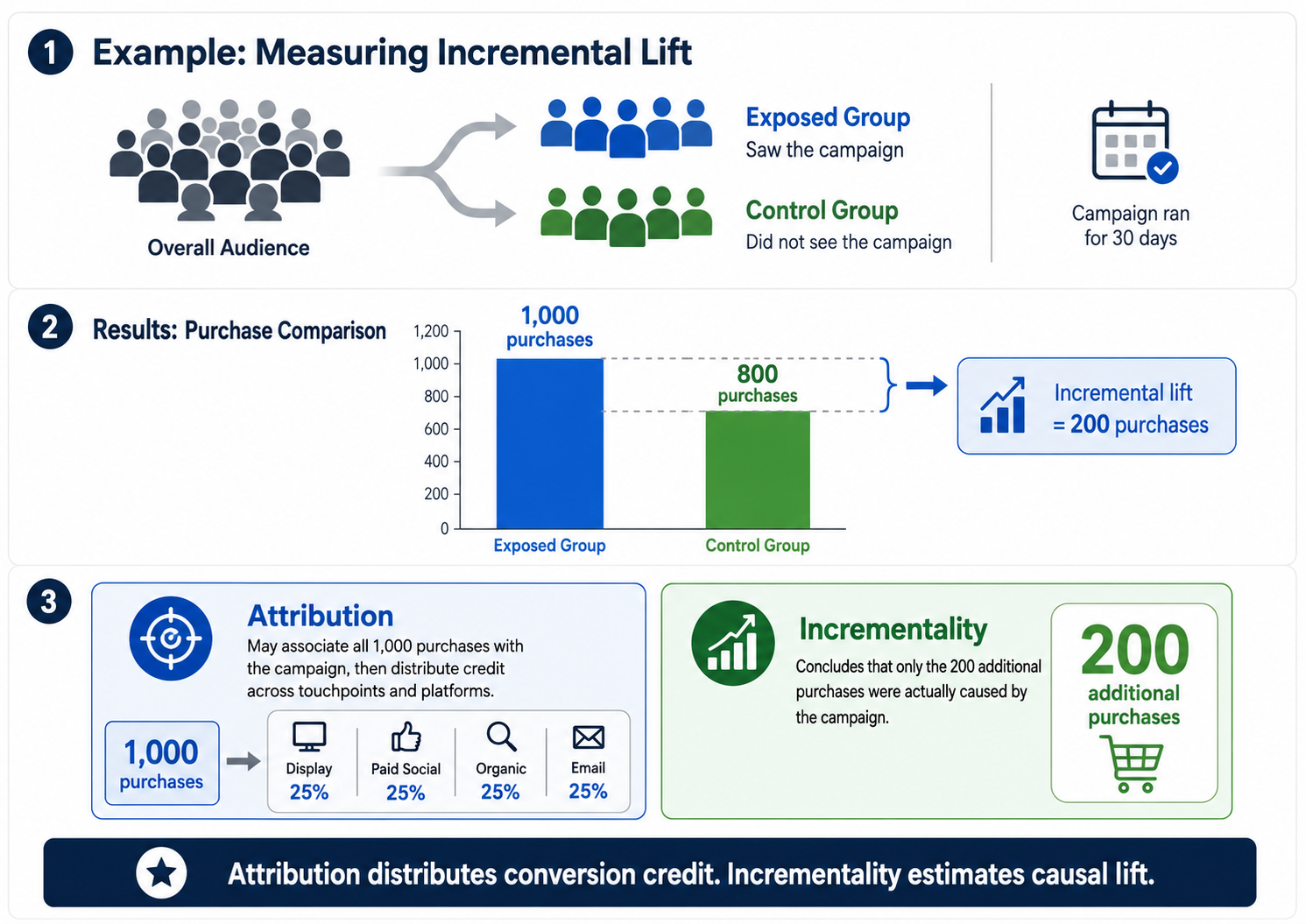
Let’s say you wish to uncover the elevate of a given advertising marketing campaign. So that you divide your viewers into two teams: a management group of oldsters who gained’t be uncovered to the marketing campaign and an uncovered group that does see the marketing campaign.
You run your marketing campaign for 30 days, then have a look at the outcomes. Whereas the uncovered group accomplished 1,000 purchases, the management group accomplished 800 purchases. The incremental elevate of the marketing campaign could be 200 purchases.
An attribution mannequin might affiliate many or all 1,000 purchases with the marketing campaign. It might allocate the worth throughout the platforms and touchpoints concerned in line with the mannequin you select.
Incrementality, then again, would conclude that solely these 200 further purchases had been truly brought on by the marketing campaign.
Dig deeper: Why attribution and impact are no longer the same thing in PPC
Get the e-newsletter search entrepreneurs depend on.
Utilizing attribution and incrementality collectively
The place entrepreneurs go mistaken is once they go all in on both framework. The 2 ideas can play properly collectively (offered you’re utilizing the fitting one to reply the fitting query). In case you’re seeking to optimize your campaigns or deep dive into the consumer journey of your buyer, attribution goes to be your finest good friend, serving to you consider platforms and touchpoints by providing you with a shared success metric with which to check them.
If, then again, you’re defending your funds from a proposed lower, incrementality goes to be your strongest supply of proof relating to which channels truly create further enterprise with their funds, somewhat than capturing enterprise that might have occurred anyway.
| Attribution | Incrementality | |
| Main query | Which noticed advertising touchpoints ought to obtain credit score for a conversion? | What number of further conversions occurred due to the advertising exercise? |
| Finest use case | Ongoing marketing campaign optimization, understanding buyer journeys, and allocating credit score throughout measurable channels. | Validating whether or not an funding creates further enterprise worth and informing higher-level funds choices. |
| Foremost blind spot | Correlation is just not causation: a touchpoint might obtain credit score for a conversion it didn’t truly create. | Assessments might be costly, sluggish, or troublesome to design, and outcomes might not clarify which particular person touchpoints influenced the client. |
| Probably stakeholder | Channel managers, efficiency entrepreneurs, platform groups, and advertising analytics groups. | Advertising and marketing management, finance, knowledge science, development technique, and funds house owners. |
The place platforms get confused by attribution and incrementality
If there’s one query that has haunted me all through my profession, it’s this one: “Why don’t these numbers match?”
Most frequently, it’s requested when a channel platform’s reported income or conversions differ from the numbers discovered within the consumer’s CRM, internet analytics, or different supply of reality. They nearly by no means line up completely.
What might be robust to elucidate succinctly to a consumer is that this: The truth that they differ doesn’t essentially imply both is inaccurate. Every system applies its personal logic based mostly on the interactions it may possibly observe, which conversions ought to qualify for credit score, and the way lengthy after an interplay credit score can nonetheless be attributed. However neither is “mistaken.”
An promoting platform might appropriately observe and report {that a} buyer considered or clicked on an advert earlier than buying. However proof that an advert was seen earlier than a purchase order isn’t essentially proof that the advert triggered it, neither is it proof that the advert didn’t trigger it.
This turns into notably vital with automated campaigns, particularly as platforms proceed to push these automated options on entrepreneurs. Automated programs are designed to maximise efficiency based mostly on the conversion indicators outlined contained in the platform. They’re merely not designed to maximise efficiency based mostly in your fastidiously calculated incremental elevate take a look at outcomes.
In consequence, automated campaigns goal audiences, placements, and queries already related to customers more likely to convert, similar to present clients, branded searchers, and remarketing audiences. These conversions could also be completely legitimate in line with the platform’s attribution mannequin, whereas creating much less further income than the marketing campaign report implies.
In different phrases, automated campaigns can enhance the variety of conversions credited to a given marketing campaign with out truly inflicting an equal enhance in whole gross sales.
Dig deeper: Your ROAS looks great — but is it actually driving growth?
A be aware on in-platform elevate research
It’s true, platforms are more and more providing elevate research and different incrementality-focused instruments. But it surely’s a mistake to imagine that incremental worth is mechanically included into automated marketing campaign optimization.
In spite of everything, “data without insights is meaningless, and insights without action are pointless.” In different phrases, a elevate research will solely have an effect on efficiency if and when somebody applies its findings to the marketing campaign’s aims, inputs, or funds choices.
A platform like Google Advertisements might provide a controlled lift experiment, however except the advertiser applies the take a look at findings — or selects a marketing campaign setting explicitly designed to optimize for incrementality — the measurement system and the supply system are nonetheless going to be working towards two totally different definitions of success.
Some platforms are beginning to tackle this. Meta, for instance, now offers a very promising incremental attribution model supposed to optimize supply towards conversions it predicts had been immediately brought on by promoting. For now, although, that’s a selected optimization alternative that, once more, requires motion by the advertiser and isn’t an inherent function of each automated marketing campaign.
Every click they win is a customer you lose.
See where competitors are investing, which keywords drive their results, and how to capture more of the market.
See who’s stealing your traffic
Know which query you’re attempting to reply
In sum, attribution and incrementality aren’t competing strategies for locating one definitive metric. They’re totally different instruments designed to reply totally different questions. And like most instruments, they carry out finest once they’re doing the job they’re designed for. You wouldn’t attempt to use your Allen wrench as a hammer, would you?
Attribution helps us entrepreneurs perceive which touchpoints contributed to a conversion and offers a shared foundation for evaluating channels. Incrementality helps companies perceive whether or not their advertising funding generated further conversions that wouldn’t have occurred in any other case.
The very best entrepreneurs want each. Whereas attribution offers the continued indicators wanted to optimize campaigns and perceive buyer journeys, incrementality helps validate whether or not these optimizations are creating new enterprise worth or just capturing demand that already existed.
As automated campaigns take higher management over focusing on, placements, bidding, and funds allocation, understanding each side will solely change into extra vital. A system can change into exceptionally environment friendly at maximizing attributed conversions with out changing into equally efficient at producing incremental development.
So the subsequent time a platform report contradicts your CRM, don’t assume both quantity is mistaken — ask which query every quantity was designed to reply.
Dig deeper: The end of easy PPC attribution — and what to do next
Contributing authors are invited to create content material for Search Engine Land and are chosen for his or her experience and contribution to the search group. Our contributors work beneath the oversight of the editorial staff and contributions are checked for high quality and relevance to our readers. Search Engine Land is owned by Semrush. Contributor was not requested to make any direct or oblique mentions of Semrush. The opinions they categorical are their very own.
#Attribution #incrementality
