
Social Signals
Keyword research meets prompt research: A smarter way to prioritize topics

Aug

I’ve spent most of my profession treating key phrase analysis as the inspiration of natural technique. It tells you what folks sort right into a search field, how usually, and with what intent.
Now there’s a second demand sign alongside it: what folks ask AI assistants. These conversations reveal demand that key phrase analysis alone doesn’t all the time seize.
When your viewers opens ChatGPT, Perplexity, or Google’s AI Mode and describes an issue in a full sentence, that question usually seems very completely different from the quick phrase they’d sort into conventional Google Search.
As an alternative of treating these as separate analysis workout routines, I began placing key phrase demand and immediate demand in the identical desk. The hole between them usually determines what sort of content material a subject really wants.
Two analysis disciplines, one desk
For each matter I’m contemplating for a brand new SEO marketing campaign, I pull two numbers.
- Key phrase quantity is what number of occasions folks sort a key phrase into search. I take advantage of Google Adverts Key phrase Planner and cross-reference the information with a third-party software, normally Semrush or Ahrefs. I begin with an inventory of goal key phrases, then use every advised key phrase to uncover associated alternatives.
- Immediate quantity is what number of occasions folks ask AI assistants. I take advantage of Profound’s Immediate Volumes software for this. It pulls from a dataset of actual prompts folks undergo ChatGPT, Gemini, Claude, and Perplexity, then fashions how usually a subject seems throughout these conversations. You enter a key phrase (or a batch of them), and it returns quantity, associated phrasing, and the way that demand developments over time. That’s the prompt-side quantity I put subsequent to conventional month-to-month search quantity knowledge.
I take advantage of this knowledge to construct a easy spreadsheet. The key phrase column represents search demand. The immediate column represents AI-answer demand. It’s additionally vital to know some nuances within the software outputs. Key phrase Planner merges shut variants, so near-duplicate phrases report the identical determine.
I wouldn’t rely them as separate demand. Immediate quantity is mostly extra directional. I discover it dependable for evaluating orders of magnitude, which is what this technique wants, however much less dependable when you rely too closely on particular numbers.
Dig deeper: Prompt research: The next layer of SEO and GEO strategy
Be the brand AI recommends.
See where your brand appears in AI search, where competitors are winning, and what it takes to become the answer AI recommends.
See your AI visibility
What the hole really tells you
As soon as each columns are crammed in, subjects can fall into a number of strategic content material buckets, relying on the connection between key phrase and immediate quantity.
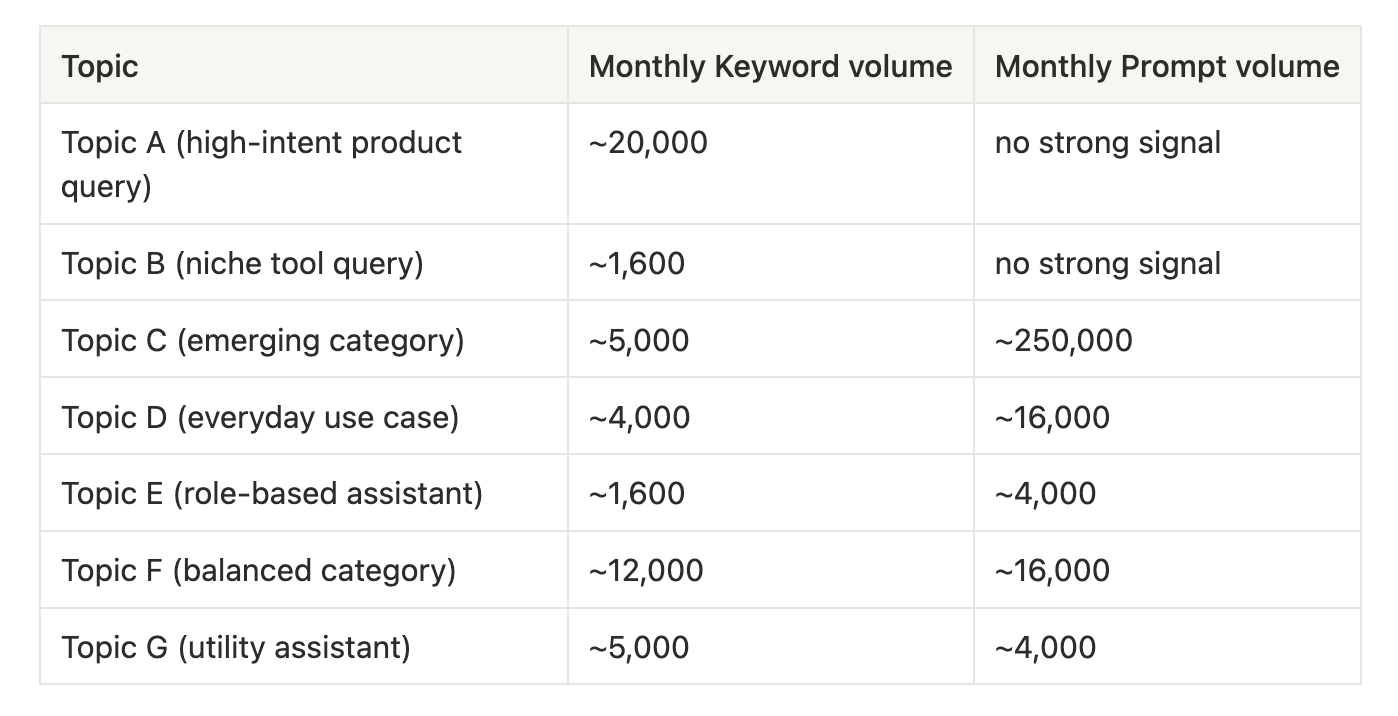
Right here’s an actual pattern from a batch I ran lately. The subjects are anonymized, and the numbers are rounded to the values reported by the instruments.
Key phrase-strong, prompt-weak: Write the basic website positioning web page
Subject A pulls roughly 20,000 month-to-month searches and nearly no immediate demand. Individuals seek for it, however they aren’t asking an assistant to stroll them by it.
Subject B follows the identical sample at a smaller scale: first rate search demand however a weak immediate sign.
For these, I begin with a keyword-led plan and keep trustworthy about the place the demand is. Persons are trying to find this in Google, not asking AI about it, no less than not but. So the temporary seems like a standard website positioning temporary.
I take a look at what’s already rating:
- What does the SERP reward for this question?
- What questions are the highest pages really answering, and the place are they skinny?
Then I ask the one query that issues for the web page I’m about to construct:
- What can I say right here that no person else is saying, and the way do I reply the searcher’s query fully?
From there, I work top-down by the complete doc.
- The title and H1 match the key phrase and intent.
- The opening solutions the query early.
- The remainder of the web page covers associated questions, definitions, and supporting data the SERP rewards.
- HTML is structured in a approach that makes the reply straightforward to parse by clear headings, quick definition blocks, and conclusions close to the highest of every part.
The purpose for this bucket isn’t to pressure an AEO rewrite onto a search question. It’s to win the key phrase based mostly on how the SERP works right this moment whereas making the web page substantive sufficient that, if AI search begins citing this matter later, there’s one thing significant to tug from.
Dig deeper: The infinite tail: When search demand moves beyond keywords
Immediate-strong, keyword-weak: Write for the reply, not the SERP
That is the group key phrase analysis alone that you’ll miss. It’s additionally the a part of the strategy I depend on most.
Subject C reviews about 5,000 month-to-month searches. Based mostly on key phrase quantity alone, I’d most likely deprioritize it. Nevertheless it pulls roughly 250,000 in immediate quantity. Key phrase search quantity understates demand for this matter by about 50 occasions. Individuals aren’t typing exact-match key phrases into Google. They’re describing the issue to an assistant and asking what to do about it.
Subject D reveals about 4,000 searches towards 16,000 prompts. Subject E follows the identical sample at a smaller scale.
For these, I would like content material constructed to be the reply itself: clear definitions, direct responses to the questions folks really ask, and a construction an LLM can extract and cite. The objective is to get cited inside the reply.
That is the place groups depart essentially the most demand on the desk. Matters can look “small” in Key phrase Planner but dominate immediate quantity, and groups that rely solely on key phrase analysis by no means even put them on the roadmap.
Get the publication search entrepreneurs depend on.
Sturdy on each: Construct the flagship
Subject F reviews roughly 12,000 searches and 16,000 prompts. Subject G sits in an analogous vary on each side. When a subject reveals demand on each surfaces, I fund it like a pillar. These are the pages value constructing to rank in search and get cited in AI solutions.
That is additionally the place the 2 analysis disciplines cease feeling like separate workout routines. Key phrase analysis tells me how you can construction and title the web page for search. Immediate analysis tells me which inquiries to reply and how you can phrase them so an assistant will pull from the web page. Collectively, they assist me construct a web page that’s designed for each surfaces.
A be aware on empty cells: When the immediate column comes again empty, don’t learn it as zero curiosity. Usually, the demand is there however bundled right into a broader head time period or completely different immediate classes. A slim use case would possibly present nothing by itself whereas rolling up underneath a a lot bigger immediate matter.
A clean means “no clear matching time period right here,” not “no person cares.” Verify the pinnacle time period earlier than you write off a subject. I’ve positively missed some good early alternatives by not following this rule.
Turning the desk into a method
The desk is simply helpful if it adjustments what you ship. As soon as subjects are sorted, the roadmap is easy:
- Key phrase-strong subjects feed the standard website positioning queue: rating pages matched to go looking intent.
- Immediate-strong subjects feed the answer-engine queue: referenceable, extractable content material designed to be cited.
- Sturdy-on-both subjects grow to be your flagships: spend money on them and construct for each surfaces directly.
Then measure the 2 surfaces individually. Break up your natural reporting so basic search visitors and AI-referred visitors are distinct, slightly than mixing every part into one “natural” quantity.
On my workforce, we separate natural search from AI search sources like ChatGPT and Perplexity, so we will see whether or not a chunk of content material is incomes visitors on the floor it was constructed for.
Constructing nice content material helps you carry out throughout website positioning and AEO. Taking a look at each demand alerts helps you resolve how every matter ought to be approached. The higher your knowledge, the extra particular your iterations can grow to be, and the extra you’ll study from each piece you publish.
Dig deeper: How to design content that AI systems prefer and promote
If AI can’t find you, customers won’t either.
Track your visibility across AI search, uncover missed opportunities, and grow your presence where customers are asking questions.
See your AI visibility
Why I’m working each now
For years, key phrase analysis was sufficient as a result of search was the one discovery floor that mattered. That stopped being true as soon as a major a part of the journey started earlier than the clicking, in a dialog that doesn’t appear like a key phrase.
Operating immediate analysis alongside key phrase analysis lets me cease guessing the place demand really exists. I can see the precise demand for a subject as a substitute of constructing the identical web page for each sort of question.
Groups that proceed treating these as a single demand sign will preserve lacking the subjects the place they diverge.
Contributing authors are invited to create content material for Search Engine Land and are chosen for his or her experience and contribution to the search group. Our contributors work underneath the oversight of the editorial staff and contributions are checked for high quality and relevance to our readers. Search Engine Land is owned by Semrush. Contributor was not requested to make any direct or oblique mentions of Semrush. The opinions they specific are their very own.
#Key phrase #analysis #meets #immediate #analysis #smarter #prioritize #subjects
