
Social Signals
The AI visibility index: Which brands are vanishing from AI search?

A number of the manufacturers with the strongest SEO footprints barely seem in AI solutions. Others with a lot smaller search footprints present up time and again.
Fractl analyzed how constantly AI fashions suggest manufacturers, which manufacturers disappear regardless of sturdy website positioning footprints, and which alerts separate the manufacturers that overperform from those who under-index. (Disclosure: I’m the co-founder of Fractl.)
The brief reply: natural authority nonetheless issues, nevertheless it’s not the entire map.
Greater than 9 in 10 manufacturers within the dataset behaved the way in which most SEOs would anticipate: stronger conventional search authority usually tracked with stronger AI visibility. However the outliers are the place the findings get attention-grabbing.
The hole between conventional search authority and AI recall is the place the visibility problem will get extra sophisticated.
AI solutions have default manufacturers
Some manufacturers with excessive area scores, massive key phrase portfolios, and hundreds of thousands of month-to-month natural visits barely surfaced in their very own classes. Others with smaller conventional search footprints appeared much more typically than their website positioning metrics would predict.
Each {industry} we reviewed had a brief record of manufacturers that surfaced time and again, no matter how the immediate was phrased.
These default solutions weren’t all the time the largest corporations within the class. They weren’t all the time the manufacturers with probably the most visitors. And so they weren’t all the time the businesses a conventional website positioning leaderboard would put first.

We observed a couple of patterns emerge instantly:
- Journey was probably the most concentrated class: Reserving.com (285 mentions), Airbnb (227), and Expedia (215) accounted for roughly 20% of the sector’s complete point out quantity. Three manufacturers accounted for one out of each 5 suggestions.
- HealthTech had a runaway chief: Teladoc (275) led Amwell (220), the runner-up, by roughly 25%. The fashions have settled.
- Wellness had the deepest bench: Peloton, Headspace, Calm, Whoop, and Oura all cleared 168 mentions. No single model dominates, which suggests the category-leader slot continues to be up for grabs.
- Insurance coverage broke the way in which {industry} watchers ought to have anticipated: Lemonade (213) ranked above State Farm (172). Root Insurance coverage (165) ranked above Progressive (114). The fashions cited the digital-native carriers first and handled the legacy ones because the alternate options, fairly than the default.
- Life-style was the loudest sign of the methodology working: Patagonia, Allbirds, Eileen Fisher, and Everlane (sustainability-coded direct-to-consumer manufacturers) outranked Sephora, Samsung, and Whirlpool. Whether or not that’s a perform of how product roundup articles get written or a deeper bias in coaching knowledge, the end result is similar: The fashions favor the model story that will get instructed in third-party content material.
The sample held throughout each sector. A handful of classes do have winners the fashions clearly acknowledge, however loads of the time, these picks don’t line up with what you’d anticipate. Stripe wins in FinTech, Notion in SaaS, Coursera in Training, and so forth. More often than not, although, the default names aren’t those you’d predict.
That’s the primary strategic shift for website positioning leaders.
The aggressive set inside an AI reply is way smaller than the aggressive set on a search outcomes web page. In case your model can’t crack the highest 5 to 10 names the mannequin remembers to your class, rating properly in Google will not be sufficient to get you into the AI-generated consideration set.
Dig deeper: Hidden gem publishers outperform major media on audience affinity: Study
Be the brand AI recommends.
See where your brand appears in AI search, where competitors are winning, and what it takes to become the answer AI recommends.
See your AI visibility
Conventional authority doesn’t assure AI recall
Greater than 9 in 10 manufacturers in our dataset had been broadly aligned: sturdy conventional search authority often tracked with stronger AI visibility. That’s the anticipated end result. It’s additionally why entrepreneurs shouldn’t throw out each website positioning precept they’ve spent the final decade constructing round.
However the edges of the dataset present the place the technique adjustments. About 5% (471 manufacturers) had been underexposed in LLMs. These had been corporations with excessive area scores, very excessive natural visitors, and a deep key phrase portfolio that also drew virtually no references from the fashions.
On website positioning infrastructure, they seem like market leaders. On LLM references, they seem like corporations no one has ever written about.

About 4% (377 manufacturers) had been AI overperformers. The fashions referenced them much more typically than their modest conventional alerts would counsel, rather more aggressively of their verticals than Ahrefs knowledge says they need to be.
Roughly 9% lined up with how typically a model appeared in third-party content material that it didn’t create. Manufacturers that confirmed up disproportionately in roundups, skilled lists, and comparability evaluations tended to be much more seen to the fashions as a result of that type of protection will get ingested into the coaching knowledge. Manufacturers with loads of search authority however little third-party protection tended to land within the underrepresented group, no matter vertical.
That’s the strategic shift: What a model says about itself issues much less for AI recall than what the remainder of the online has repeatedly mentioned about it. Owned content material nonetheless issues. Technical website positioning nonetheless issues. However for AI visibility, the corroboration layer is turning into more durable to disregard.

Some manufacturers are miscategorized
The manufacturers underrepresented in AI are, in lots of instances, the blue chips of their classes by most conventional measures. These manufacturers have area scores above 80, hundreds of thousands of month-to-month natural visits, and tons of of 1000’s of key phrases ranked. However the fashions don’t even point out them in their very own sectors.
The difficulty is categorization.

A number of of the patterns we noticed:
- Microsoft and Spotify topped the record in FinTech: They’re the giants of conventional visibility, however the fashions didn’t categorize them as fintechs when prompted with fintech queries. That’s not a bug. Microsoft is closely cited while you ask about productiveness software program or cloud platforms. It’s a categorization hole. The fashions have determined what counts as a fintech, and Microsoft wasn’t on the record.
- Legacy insurance coverage carriers acquired displaced: Aetna, Cigna, Humana, Liberty Mutual, and Trustpilot all sat at DR 80+ with hundreds of thousands of month-to-month visits. The fashions barely cited them. Lemonade and Root sat greater in the identical prompts regardless of a fraction of the standard footprint.
- Legacy retail manufacturers acquired displaced: Sephora, Samsung, Whirlpool, and GE Home equipment. The fashions most popular Patagonia, Allbirds, and Eileen Fisher when the immediate requested for way of life suggestions. That is probably the most seen sign that the coaching knowledge closely weights direct-to-consumer model narratives over legacy retail.
- Healthcare giants had been under-indexed. Medtronic, GoodRx, Humana, and 23andMe. The fashions cited telehealth-native manufacturers like Teladoc, Amwell, and Doxy.me as an alternative.
Low recall doesn’t all the time imply the mannequin doesn’t know your model. It might imply the mannequin has filed your model underneath a unique class than the one your patrons are looking.
Extra content material alone gained’t repair that.
You want stronger class alerts within the locations fashions are prone to encounter and reinforce these associations: analyst content material, {industry} publications, comparability pages, companion pages, buyer tales, evaluation websites, and category-specific media protection. Earlier than you chase extra AI mentions, make certain the fashions perceive which class you’re speculated to win.
Dig deeper: What 1 million keywords reveal about AI’s impact on search
Get the publication search entrepreneurs depend on.
The AI overperformers present the playbook
The opposite aspect could also be much more useful to entrepreneurs, because it reveals how manufacturers punching above their weight truly pull it off. Smaller Ahrefs profiles. Bigger mannequin recall. And all 377 of those manufacturers present up repeatedly within the third-party materials the fashions had been skilled on.

This record tells the story:
- Monday.com was the largest overperformer within the dataset, with an AI Visibility Rating of 0.71. Monday.com already has lots of conventional visitors, near 1 million natural guests, and greater than 50,000 ranked key phrases. Its overperformer standing tracks instantly with how rather more typically the fashions referenced it than its SaaS friends.
- Root Insurance coverage owned the insurance coverage class outright, drawing extra AI references than any of the legacy carriers regardless of being a fraction of their measurement.
- Six of the highest 15 overperformers had been in training: Stanford, MIT, Khan Academy, LinkedIn Studying, IBM Information Science, and Google Profession Certificates. The fashions cited these for his or her credibility, not as a result of they run high-Area-Ranking industrial platforms.
- Smaller gamers adopted the identical sample. Doxy.me, Nike Coaching Membership, and Google Flights all acquired pulled into product roundups, confirmed up closely on skilled lists, and drew an outsized variety of LLM references because of this.
The widespread thread isn’t simply “good website positioning.” It’s category-level presence in different individuals’s content material. That pushes AI visibility work nearer to digital PR, content material distribution, and class authority constructing than many groups wish to admit.
If you wish to know why a competitor with lower than half your natural visitors reveals up within the mannequin’s reply when you don’t, the query to ask isn’t, “What’s their website positioning technique?” It’s, “What’s their press protection, and the way did they earn it?”
You’re not simply optimizing your personal web site. You’re shaping the set of sources AI programs use to grasp who belongs within the class.
Most manufacturers exist in just one mannequin’s world
Solely 900 manufacturers in our dataset, or 11% of the full, had been referenced by all three fashions. One other 12% appeared in two. The overwhelming majority, 77%, had been referenced by just one mannequin.

That’s a significant measurement drawback. A model can win in ChatGPT and lose in Gemini. It might present up in Claude and disappear from ChatGPT. It might personal one mannequin’s reply set whereas barely registering in one other.
Every mannequin additionally had a unique fingerprint.
- Claude leaned extra closely towards SaaS and insurance coverage manufacturers, with Notion, Linear, and Lemonade showing extra typically there than within the different two fashions.
- Gemini leaned towards journey and healthcare, with Reserving.com, Teladoc, and Livongo showing at a a lot greater fee.
- ChatGPT was probably the most consensus-driven of the three, with probably the most overlap between its prime manufacturers and the opposite fashions.
The heatmap reveals how erratically distributed even consensus manufacturers are:
The gaps weren’t all the time refined. Notion was cited 17 occasions extra typically by Claude than by Gemini. Whoop appeared virtually 4 occasions extra typically in Claude than Gemini. State Farm drew virtually half its mentions from ChatGPT and solely a few quarter from Gemini.
That is why combination AI visibility scores can mislead senior groups. If a dashboard says your “AI visibility” improved, your first query ought to be: The place?
A single blended rating can conceal the precise drawback. Chances are you’ll not have an AI visibility drawback broadly. You could have a Gemini drawback. Or a Claude drawback. Or a class immediate drawback. Or a supply drawback.
Measure every mannequin individually. Monitor prompts by class and intent. Have a look at which sources seem repeatedly. Then determine the place the hole is price closing.
Some sectors have already been re-sorted
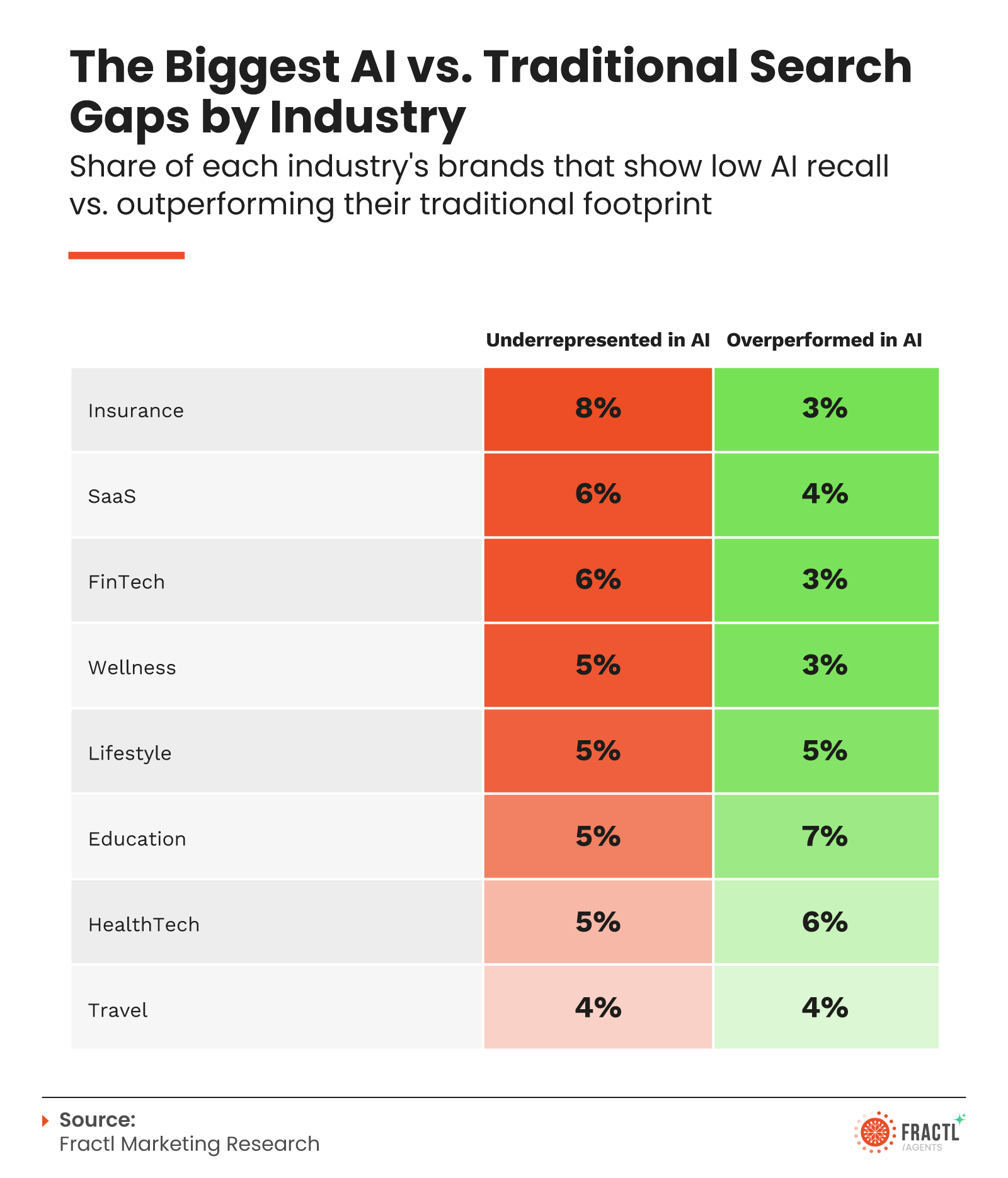
The disconnect between conventional authority and AI recall wasn’t evenly distributed throughout industries. Some sectors nonetheless look rather a lot like Google, whereas others have been virtually fully re-ranked by the fashions.
The sample breaks down otherwise by sector:
- Insurance coverage was the least represented, at 8%. Legacy carriers like Aetna, Cigna, Humana, and Liberty Mutual had been changed by digitally native carriers. In case you’re a longtime provider, you might have the biggest hole between your Google authority and your AI recall.
- Training had the best overperformer fee, at 7%, with Stanford, MIT, Khan Academy, IBM Information Science, Google Profession Certificates, and LinkedIn Studying dominating. Skilled training and establishments do higher right here than the industrial platforms as a result of they generate credibility content material.
- HealthTech was impartial (underrepresented by 5%, overperforming by 6%), with a shift underway from pharma and medical machine corporations to consumer-facing digital well being.
- Journey had the smallest disconnect (4% underneath, 4% over) as a result of LLM recall and conventional consciousness lined up intently. In journey, Reserving.com, Expedia, and Airbnb are the best-known names to each Google and the fashions. Journey’s prime performers are steady.
- SaaS and FinTech sat between 3% to 4% over and 6% underneath. That’s as a result of in these classes, the story is one incumbent changing one other (Stripe vs. PayPal, Notion vs. Microsoft) fairly than new entrants displacing the outdated guard totally.
The sample throughout sectors mirrors the broader discovering. The place the legacy authority of a class was constructed totally on website positioning and visitors, the fashions have re-sorted. The place the class was constructed round model tales that circulated in third-party media, the alignment is tighter.
What this implies for model technique
These are my 5 fundamental classes from the examine, roughly ordered by how rapidly you may act on them.
Measure conventional search authority and AI recall individually
Area ranking, natural visitors, and key phrase rankings nonetheless matter. They simply don’t inform the entire story.
A model can rank properly on Google and nonetheless fail to indicate up in AI solutions. One other model can have a smaller conventional website positioning footprint and nonetheless change into a default advice. Monitor each.
Measure the place you rank in Google and the place you seem in AI responses. Then search for mismatches. The mismatches are the place the technique lives.
Construct third-party validation, not simply owned content material
The manufacturers that outperform in AI responses have a tendency to look repeatedly in different individuals’s content material. That features:
- Roundups.
- Finest-of lists.
- Comparability articles.
- Skilled evaluations.
- Analyst pages.
- Podcasts.
- YouTube transcripts.
- Neighborhood discussions.
- Class-specific writer protection.
Owned content material may help make clear your positioning, nevertheless it gained’t exchange exterior corroboration. If AI programs are constructing solutions from the broader net’s understanding of your model, digital PR turns into one of the vital sensible levers for AI visibility.
Monitor every mannequin individually
Solely 11% of manufacturers had been referenced by all three fashions. That ought to kill the concept that “AI visibility” is one clear metric. Measure ChatGPT, Gemini, and Claude individually. Break prompts out by product class, purchaser intent, and comparability set.
Monitor whether or not your model seems, the way it’s described, which rivals seem with it, and which sources appear to help the reply. A model-specific miss provides you a a lot clearer motion plan than a blended visibility rating.
Repair categorization earlier than you chase quantity
In case your model has sturdy general consciousness however weak recall in your goal class, the problem could also be categorization. The mannequin could know who you might be. It simply could not assume you belong within the reply set for the queries that matter. That requires a unique technique.
You want extra category-specific proof: media protection, comparability content material, companion references, buyer tales, awards, evaluations, and third-party pages that repeatedly join your model to the class you wish to personal.
Transfer earlier than the default-answer slot hardens
Some classes are nonetheless huge open. Wellness, way of life, and elements of HealthTech nonetheless have room for brand new default solutions.
Others are already consolidating. Journey, main SaaS classes, and elements of FinTech are a lot more durable to interrupt into as a result of the fashions already return a decent set of acquainted names.
The sooner you construct class affiliation, the simpler it’s to affect recall. As soon as a mannequin repeatedly sees the identical manufacturers hooked up to the identical class, dislodging them will get more durable.
If AI can’t find you, customers won’t either.
Track your visibility across AI search, uncover missed opportunities, and grow your presence where customers are asking questions.
See your AI visibility
What the online says about your model issues
Your subsequent model visibility audit shouldn’t cease at your web site. It ought to map the sources that educate fashions who belongs in your class: roundups, comparisons, skilled lists, writer protection, evaluations, companion pages, and neighborhood discussions.
That’s the place the overperformers on this examine separated themselves, not by being the largest manufacturers in natural search, however by being repeatedly bolstered within the locations AI programs use to grasp, examine, and suggest corporations.
Methodology
Fractl analyzed AI visibility throughout eight industries utilizing GPT-4o, Gemini 2.5 Flash, and Claude Sonnet 4.6. Every mannequin obtained the identical 96 industry-specific prompts, with every immediate run 15 occasions per mannequin. The evaluation produced 4,320 responses and greater than 8,500 distinctive model references.
Fractl then mapped the manufacturers recognized in these responses to Ahrefs knowledge, together with area ranking, natural visitors, referring domains, and key phrase quantity. This made it attainable to match every model’s conventional search authority with how regularly it appeared in AI-generated responses.
The evaluation grouped manufacturers based mostly on how their AI visibility in contrast with their conventional search efficiency. Manufacturers that appeared much less typically than their website positioning metrics would counsel had been categorized as underrepresented, whereas manufacturers that appeared extra typically had been categorized as overperformers.
Contributing authors are invited to create content material for Search Engine Land and are chosen for his or her experience and contribution to the search neighborhood. Our contributors work underneath the oversight of the editorial staff and contributions are checked for high quality and relevance to our readers. Search Engine Land is owned by Semrush. Contributor was not requested to make any direct or oblique mentions of Semrush. The opinions they specific are their very own.
#visibility #index #manufacturers #vanishing #search
