
Social Signals
Google’s Universal Commerce Protocol: The SEO implications

Jul

So long as I’ve been in search advertising, the trail has been easy: search question → click on → purchase.
SEO adopted the identical mannequin, with natural site visitors, impressions, and click-through fee (CTR) serving as its major measures of success.
Google’s Universal Commerce Protocol (UCP) indicators the place search is headed, shifting from a discovery engine to a transaction layer.
Pushed by the rise of “agentic commerce,” Google can now uncover, consider, examine, and full purchases completely inside its AI-powered experiences, together with AI Mode, Gemini, YouTube, and Gmail.
The search engine marketing implications are important. We’re shifting from optimizing for clicks to optimizing for AI transactions. In case your model doesn’t communicate the language of UCP, you threat turning into invisible to the following technology of consumers.
Right here’s what UCP is, why it’s reshaping digital advertising, and the right way to adapt your search engine marketing technique.
UCP: The infrastructure behind AI transactions
UCP is an open-source, vendor-agnostic normal that permits your entire commerce lifecycle, from discovery and cart constructing to checkout and post-purchase monitoring, inside AI interfaces.
Co-developed by Google with Shopify, Walmart, Goal, Wayfair, Etsy, and different ecosystem leaders, UCP acts as a common translator between AI purchasing brokers and retailers’ storefront backends.
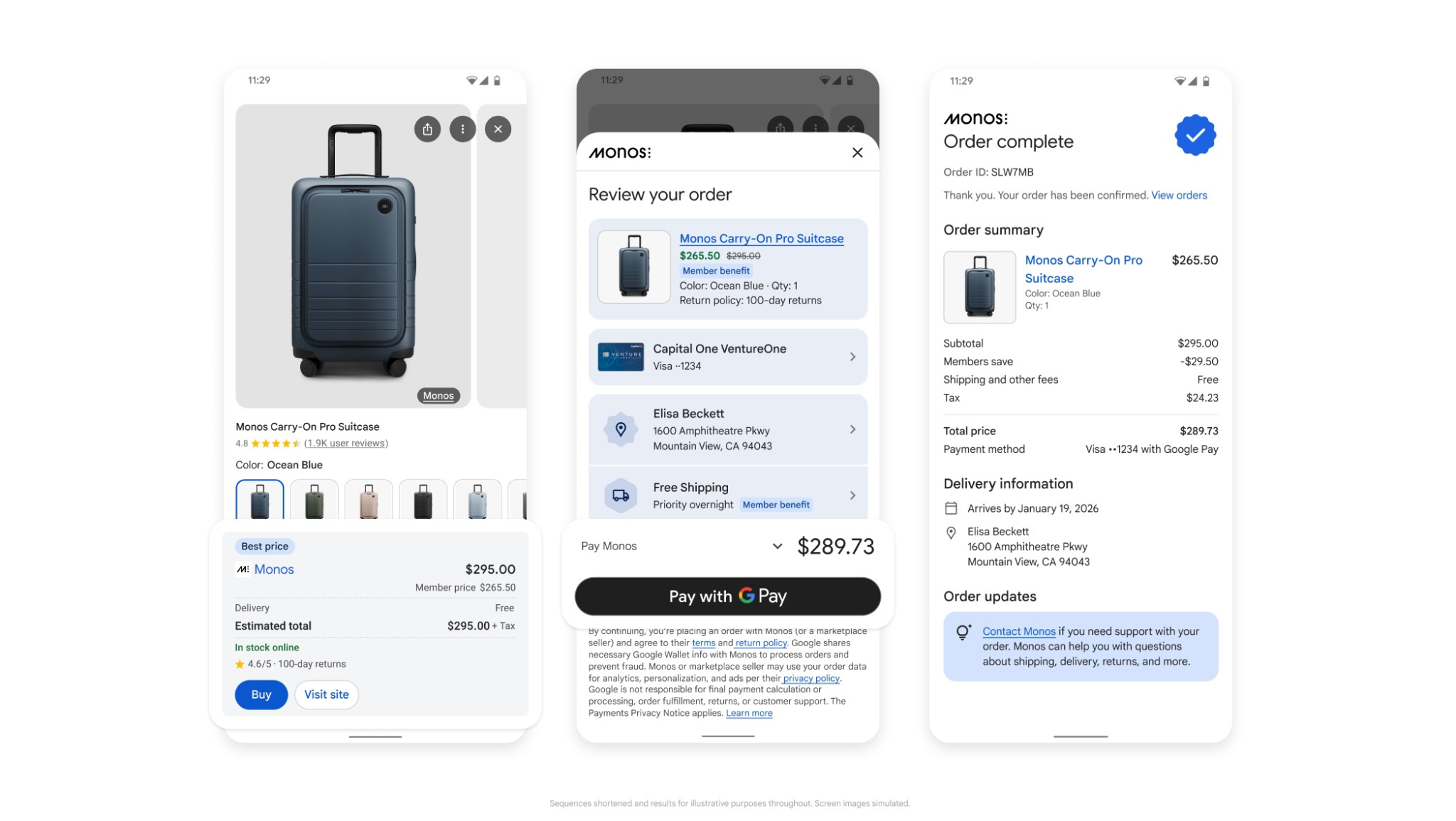
Consider UCP because the ecommerce equal of HTTPS. Simply as HTTPS standardizes safe communication between net browsers and servers, UCP standardizes how AI brokers work together with on-line shops. As a substitute of requiring customized one-to-one integrations for each service provider, AI brokers can securely browse stock and full purchases throughout hundreds of thousands of on-line shops.
Be the brand AI recommends.
See where your brand appears in AI search, where competitors are winning, and what it takes to become the answer AI recommends.
See your AI visibility
How AI transactions move by way of UCP
When somebody asks AI Mode to “discover and order a alternative water filter for a 2021 Samsung French-door fridge with the quickest delivery,” UCP handles the transaction by way of a structured workflow.
Functionality publication
The service provider publishes its service provider capabilities, together with product search, stay pricing, achievement choices, and accepted fee strategies.
Handshake
The AI agent reads the service provider profile, matches it with its personal capabilities, and establishes a safe path ahead, corresponding to aligning on loyalty applications or supported digital wallets.
Motion execution
The AI searches for the product, verifies real-time stock, builds the cart, and makes use of the Agent Funds Protocol (AP2) to finish a safe, tokenized transaction.
Human escalation
If consumer enter is required, corresponding to deciding on a supply window or confirming a delivery tackle, UCP pauses the transaction, prompts the consumer, after which arms management again to the AI to finish the workflow.
Dig deeper: How Google’s Universal Commerce Protocol could reshape search conversions
Get the publication search entrepreneurs depend on.
Why UCP issues for search and search engine marketing
UCP isn’t only a technical replace. It modifications how AI discovers, evaluates, and purchases merchandise. Right here’s why it issues for search engine marketing.
1. From click-throughs to buy-throughs
In an agentic search surroundings, web site site visitors is now not the one measure of enterprise worth. As Google rolls out options like Common Cart, permitting customers so as to add merchandise from a number of retailers to a single Google cart and take a look at with Google Pockets, the shopping for journey turns into a lot shorter.
Customers might by no means go to your homepage, class web page, or product element web page. Your search engine marketing goal shifts to incomes product choice throughout the AI advice layer, turning a search question right into a sale with out intermediate net site visitors.
2. The rise of hyper-personalized, conversational queries
Key phrase analysis is evolving. Customers are now not trying to find “males’s trainers.” They’re utilizing extremely particular, situational prompts, corresponding to “Greatest trainers for flat ft beneath $150 that may arrive by Friday.”
To match these queries, engines like google want greater than on-page copy. They want wealthy, queryable product attributes. UCP bridges that hole, permitting AI brokers to match your stock with extremely particular consumer requests.
3. Much less checkout friction
Cart abandonment stays a persistent ecommerce problem, usually attributable to prolonged types, damaged checkout flows, or sudden delivery prices. As a result of UCP integrates with safe digital wallets and passes verified consumer knowledge mechanically, it removes a lot of these friction factors.
For prime-intent, pressing, or repeat purchases, retailers that assist UCP can seize extra conversions than opponents that ship customers to a separate checkout expertise.
4. Retailers retain model management and buyer possession
When a transaction occurs by way of UCP, the service provider stays the Service provider of Report. Manufacturers nonetheless management pricing, achievement, and return insurance policies whereas retaining buyer relationships and first-party knowledge. UCP merely supplies the infrastructure that permits AI-powered transactions.
Dig deeper: Winning the AI decision layer: From AI discovery to agentic commerce
The way to put together your model for UCP
In case your search engine marketing technique is proscribed to weblog articles and meta descriptions, you’re overlooking the technical infrastructure behind AI-powered commerce. To make your merchandise eligible for UCP-powered search experiences, concentrate on these priorities.
Optimize your Service provider Middle feed
Your Google Service provider Middle (GMC) account is now not only for Buying adverts. It’s turning into the first supply of product knowledge for AI discovery.
- Allow the
native_commerceattribute: To choose into UCP-powered checkouts, add thenative_commerceattribute to your product feed. Google recommends utilizing supplemental feeds to use it on the product degree with out affecting your major feed. - Map product identifiers: Guarantee each product ID in your GMC feed maps one-to-one along with your inner checkout API. In the event that they don’t match, use the
merchant_item_idattribute to align them. - Full your coverage knowledge: Preserve your returns, delivery, and buyer assist info full and updated. AI brokers prioritize retailers with clear coverage knowledge.
Align structured knowledge along with your product feed
AI search depends on constant knowledge throughout your web site and Service provider Middle. Preserve your Product, Provide, and Assessment schema synchronized along with your product feed. Variations between the 2 can set off validation points that make merchandise ineligible for AI-powered checkout.
Put together for conversational attributes
Google is introducing new semantic attributes designed for conversational AI search. Begin getting ready your stock programs to offer:
- Actual-time stock availability.
- Direct solutions to product FAQs, corresponding to “Is that this jacket mechanically cleanable?”
- Product compatibility knowledge, together with accent pairings, sizing guides, and model-specific replacements.
If AI can’t find you, customers won’t either.
Track your visibility across AI search, uncover missed opportunities, and grow your presence where customers are asking questions.
See your AI visibility
Past clicks: search engine marketing’s subsequent alternative
The Common Commerce Protocol displays a broader shift in search. For SEOs, that expands our function past driving site visitors.
By prioritizing structured product knowledge, knowledge readiness, and agentic commerce, you’ll be able to place your model to seize demand for the time being of intent.
The way forward for search isn’t nearly getting discovered. It’s about getting purchased.
Contributing authors are invited to create content material for Search Engine Land and are chosen for his or her experience and contribution to the search neighborhood. Our contributors work beneath the oversight of the editorial staff and contributions are checked for high quality and relevance to our readers. Search Engine Land is owned by Semrush. Contributor was not requested to make any direct or oblique mentions of Semrush. The opinions they categorical are their very own.
#Googles #Common #Commerce #Protocol #search engine marketing #implications
