
Social Signals
How AI is merging paid and organic visibility

Jun

The concept AI is killing promoting misses the larger shift. As AI expands throughout search, assistants, productiveness instruments, and transactions, promoting is transferring with it.
Advert density could also be altering inside AI experiences, however promoting alternatives are increasing throughout a rising variety of surfaces.
On the identical time, paid and natural have gotten more durable to separate. The identical AI programs more and more energy advert campaigns, search experiences, and model visibility throughout Google’s ecosystem.
That modifications how manufacturers ought to take into consideration visibility.
Paid and natural are now not separate channels competing for a similar click on. They’re more and more alternative ways of influencing the identical AI programs, which suggests the alerts shaping natural visibility can also have an effect on paid efficiency.
The outdated mannequin: Paid and natural on one finite SERP
Google’s SERP was a finite floor: 10 natural blue hyperlinks, a couple of advert slots, and a information panel on the best. The person landed, scanned, and clicked.
Paid and natural groups operated on separate budgets, separate instruments, and separate quarterly stories, and barely talked to one another as a result of handbook Google Adverts stored the paid specialist busy full time. Titles, descriptions, bids, and marketing campaign construction had been all chosen by hand and required fixed consideration, which is why the natural crew had no half in any of it.
DSA modified that for me. It learn my natural pages to determine which adverts to run, who to indicate them to, when, at what bid, and what title to make use of. I managed the descriptions. The engine determined every part else, and it did it higher than I’d’ve carried out manually as a result of it was studying the identical alerts the natural aspect was already optimizing for.
When somebody at Google in Singapore defined how PMax labored, I believed, “That’s precisely what I used to be doing.”
PMax took the DSA logic and prolonged it throughout each Google floor concurrently: Search, YouTube, Gmail, Show, Maps, and Purchasing, multi function marketing campaign, with the engine making each placement determination out of your property and viewers alerts.
AI Max introduced the identical intelligence into Search campaigns, particularly, with Gemini beneath as a substitute of guidelines. PMax and AI Max run on the identical Gemini mind: one targeted on Search, the opposite unfold throughout each floor, making use of the identical funnel logic to totally different contexts with totally different sign layers on high.
And if Gemini’s understanding of your model is skinny, it fills these selections with no matter it thinks will work, which isn’t essentially your model narrative, and you haven’t any direct method to override it. You practice it, otherwise you lose management of your individual adverts.
Be the brand AI recommends.
See where your brand appears in AI search, where competitors are winning, and what it takes to become the answer AI recommends.
See your AI visibility
The brand new mannequin: Gemini sits inside each floor, and it carries adverts with it
Gemini now sits inside each layer of the Google ecosystem:
- Discovery (Search, Maps, YouTube, Lens, Information, Uncover, and Purchasing), productiveness (Gmail, Docs, Drive, Pictures, and Calendar).
- Distribution (Android, Chrome, Google Play, Pixel, Put on OS, Google TV, and Nest).
- Transaction (Google Pay, Pockets, Flights, Accommodations, and Journey).
- Assistive surfaces themselves (AI Mode, AI Overviews, Assistant, NotebookLM, and the Gemini app).
That’s what number of related customers spend most of their workday, and most of these surfaces both carry adverts now or have the infrastructure to start out carrying them.
Microsoft Promoting sits inside Copilot throughout Bing, Edge, Home windows Shopper, Workplace Shopper, Groups Free, and GitHub.
OpenAI Adverts launched in February for logged-in customers on Free and Go tiers within the U.S., inserting adverts beneath ChatGPT responses and clearly labeling them as sponsored. By Might, OpenAI had opened a self-serve Ads Manager and was increasing internationally.
The adverts layer travels with the engine, the engine is in all places, and adverts subsequently have the potential to be in all places. Most manufacturers nonetheless deal with paid as a separate channel run by a separate crew on a separate dashboard, which is a search-era inheritance that was by no means splendid however now must be dropped.
Efficiency Max already runs the public sale throughout YouTube, Show, Search, Uncover, Gmail, and Maps as one marketing campaign kind. Search is one floor amongst many, and the “adverts are dying in AI search” narrative is measuring the flawed factor. It sees advert slots compress contained in the assistive interface whereas ignoring that the floor base has multiplied by an order of magnitude.
Advert density follows the delegation the person has made to the machine
The dominant narrative in 2026 is that adverts are dying as a result of AI is changing search, and adverts inside AI are an issue no person has totally solved but. That’s partially appropriate: Advert density per session drops as AI takes extra management, and no person – together with Google – has but discovered methods to insert adverts into the AI response itself with out killing the expertise that makes the AI priceless within the first place.
However that is the half the evaluation will get flawed: This doesn’t add as much as fewer adverts total.
Search adverts are Google’s goose with the golden egg, and the goose could also be slowing down — although no person exterior Google really is aware of, as a result of Google doesn’t get away search advert income from YouTube, Show, and the remaining. That ambiguity is doing loads of work.
What we do know is that whole advert income has stored rising at the same time as AI has taken over extra of the search expertise, which proves the flock is already working.
Kodak invented the digital digicam after which buried it to guard film-processing income, and we all know how that ended. Google seems to be doing what Kodak didn’t: constructing the substitute whereas the unique continues to be worthwhile.
Each floor Gemini sits inside is a brand new chicken within the flock, every laying a smaller egg that grows over time, and when Google lastly cracks adverts contained in the AI response itself, that’s yet another goose. The floor base has expanded sooner than density has dropped, and the ad-density downside in Search and AI is short-term.
The extra the person delegates selections to the machine, the much less room the machine has to floor a paid choice. Search retains the person in cost, so the engine surfaces adverts the person would possibly choose. Assistive narrows the choices, so a sponsored slot nonetheless has an opportunity. Agentic executes the choice, so the advert has no person to steer. Advert density follows that delegation, mode by mode, with AI deciding which brands win at each mode.

Google is operating two strikes without delay, and it appears most individuals have observed solely the primary one. Gemini is taking on the advice, concentrating on, and public sale logic on surfaces which have carried adverts for years. And Google is including adverts to surfaces the place they had been beforehand absent, with AI Overviews now eligible for adverts above, beneath, and throughout the reply, and AI Mode testing conversational advert codecs.
The primary transfer is AI taking on the present advert enterprise. The second is the advert enterprise increasing into surfaces it by no means occupied. The online impact is extra AI-driven adverts throughout extra of the stack than ever earlier than.
The freemium system nonetheless works, however the advert is turning into a part of the floor
The monetization mannequin that works at client web scale is straightforward: pay with cash, or pay with consideration.
- YouTube is Google’s clearest instance — and proof that it really works: free with adverts, paid with out, and the overwhelming majority of customers have all the time chosen adverts.
- Gmail attracts the identical line: The place the person pays immediately, Google doesn’t insert adverts. The place the person pays with consideration, Google monetizes it.
I realized about freemium the exhausting manner. When our youngsters’s media firm, Boowa & Kwala, survived the dot-com crash, we added a paid tier that eliminated the adverts. Out of 1,000,000 distinctive guests a month, a couple of hundred paid. Nearly no person selected to pay.
The freemium contract — free entry in trade for adverts — is the deal they actively choose, and the numbers show it. And for ad-driven companies, pure quantity makes the cash. In Large Tech, Google has the clear benefit.
- ChatGPT is already operating adverts on free tiers.
- Gemini is ad-free with out login, however that’s a launch state, not a everlasting mannequin.
- Perplexity is obstructing customers as a substitute of monetizing them, which is a special guess on the identical downside — and a guess with a restricted runway.
Each AI floor is within the means of touchdown on the identical reply as a result of there isn’t a different reply.
What modifications is how the adverts seem. The basic SERP advert was clearly labeled and set off in a coloured panel. The Gemini advice that surfaces a product inside a Gmail context, the Copilot suggestion that names a vendor inside a Phrase doc, and the agent that picks a provider on the person’s behalf are one thing else completely.
The advert turns into ambient. It dissolves into the floor, and what promoting appears like turns into more durable to determine as promoting. Gemini reads context and intent with sufficient precision that an advert positioned in a gathering abstract can really feel helpful relatively than disruptive, which is a danger profile Google’s rules-based programs may by no means have accepted.
At Boowa & Kwala, after we scaled free ad-supported views from 100 million to 1 billion, income multiplied by roughly two, and prices rose by round 20%. Floor (a.ok.a. pageviews) multiplied tenfold, income doubled, prices grew by a fifth, and we went from worthwhile to considerably extra worthwhile.
The goal was by no means to push income up on the identical charge as floor growth. It was to maintain increasing the floor, figuring out the incremental supply value was negligible.
Google’s ratios at planetary scale differ from ours, however the structural form virtually definitely doesn’t: floor growth plus near-zero incremental value equals revenue progress, no matter whether or not income per floor retains tempo.
Get the e-newsletter search entrepreneurs depend on.
Cohort, intent, and revenue drive each paid and natural
PMax, AI Max, AI Overviews, AI Mode — Gemini is driving all of them. The AI optimizing your paid campaigns is similar AI evaluating your natural content material, studying the identical person, in the identical second, with the identical intent.
The engine reads three alerts:
- Cohort.
- Intent.
- Revenue.
In paid, you declare all three explicitly if you construction your campaigns. In natural, the engine infers all three from conduct: clicks, dwell time, and return-to-search function proxies for the revenue sign that’s lacking there. Google denied utilizing behavioral alerts for years. Its personal court case documentation advised a special story.
Which suggests the natural self-discipline the entire sequence has been constructing — the funnel query pathway, the entity home, and the corroboration stack — has all the time been pointing at one factor: engineer the web page so exactly for the best cohort that the behavioral sign does the identical job as a accurately structured PMax marketing campaign. The person lands, stays, converts, and doesn’t return and analysis the identical factor once more. Google reads that conduct and infers your revenue tier.
My guess, and I wish to be clear it’s a guess relatively than a documented reality, is that Gemini can’t serve a paid advert in actual time with out grounding towards present search outcomes as a result of the advert has to match the natural context it’s showing in.
If it doesn’t floor, the advert is inconsistent with what the person sees organically, which breaks the expertise and loses the press. So the grounding course of for paid is similar course of as for natural: identical information graph, identical search index, identical LLM.
Meaning coaching Gemini in your model by natural improves your paid efficiency by the identical mechanism. One coaching funding, two outputs. I’ll be confirmed proper on this finally, and this text is the timestamp.

You may’t immediately goal Gemini in AI surfaces. You may solely practice it.
Throughout AI-driven placements, Gemini decides every part: the place to indicate your advert, what to indicate, methods to present it, who to indicate it to, when, and at what bid. The advertiser feeds it data and units the parameters, however Gemini makes each determination that issues.
What you’re shopping for if you spend on Google Adverts in 2026 is the best to feed a advice system that analyzes your model by itself phrases. The express alerts you declare in paid — cohort, intent, and revenue — are an actual benefit over natural, the place the engine has to deduce all three from conduct.
However your capacity to dominate by pure marketing campaign construction is vastly decreased when Gemini doesn’t perceive or belief your model. The management has shifted: you information it by sign readability, not by the settings dashboard, and that steering works greatest when your natural basis is strong.
Use paid to seek out the mixtures that work, construct natural pages round them
In a accurately structured PMax or AI Max marketing campaign, you declare cohort, intent, and revenue margin explicitly: this viewers, this aim, this margin, in the identical marketing campaign. You don’t combine a luxurious lodge and a price range guesthouse in the identical advert group as a result of the cohort is totally different, the revenue margin is totally different, and handing the engine a combined sign makes it spend your price range resolving a contradiction you created.
Natural doesn’t allow you to declare revenue immediately. The engine infers it from who landed, who stayed, who transformed, and who by no means got here again to look for a similar factor. That behavioral sign is the one proxy it has for the revenue tier, and it’s a skinny sign in comparison with the specific declaration you make in paid.
The neatest transfer for any model operating each is to deal with them as a single loop. Run paid to seek out which cohort-intent-profit mixtures really convert. Construct the natural pages round these mixtures, designed so exactly for the best cohort that the conduct on the web page sends the engine the identical sign the paid marketing campaign explicitly declared.
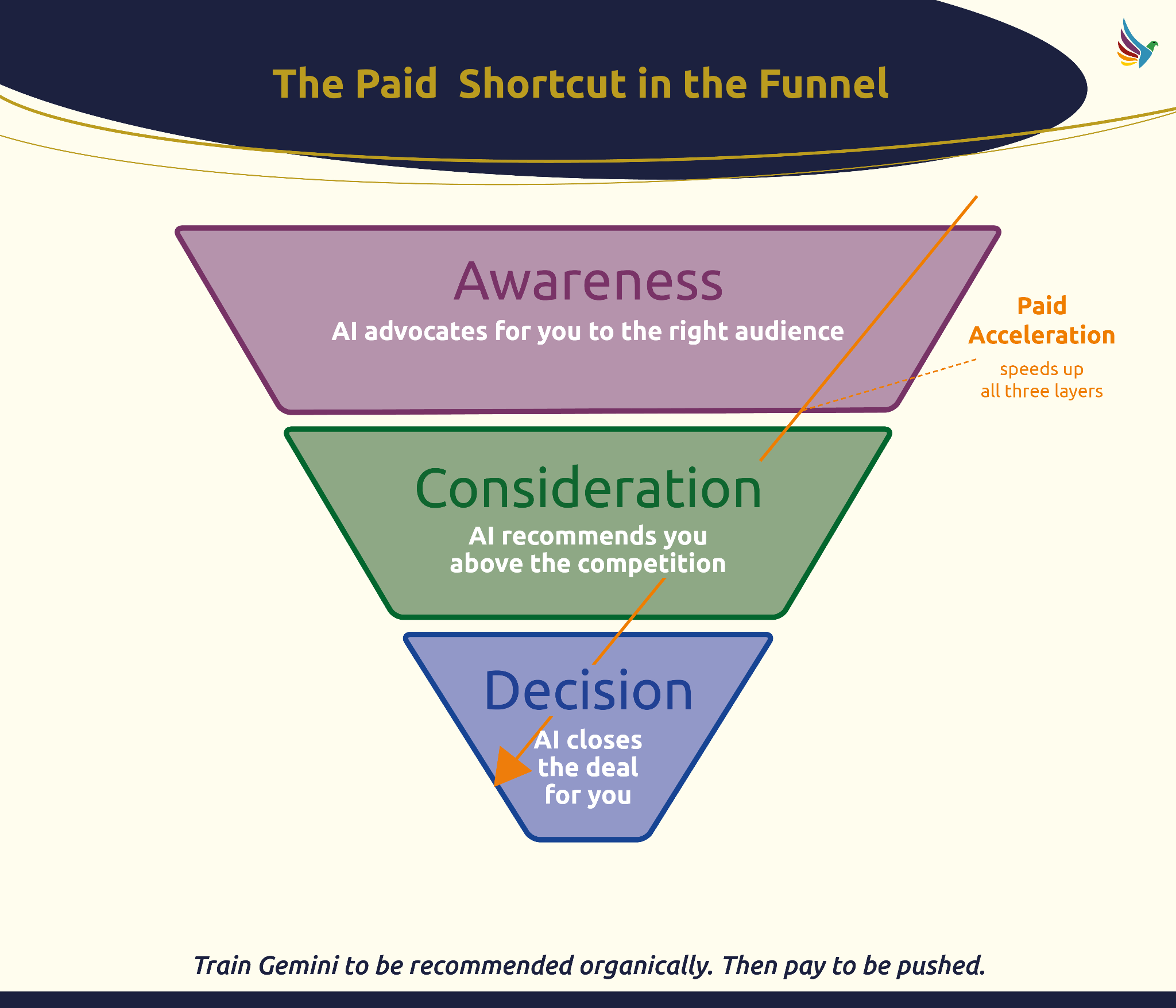
The paid aspect turns into cheaper as a result of natural pages present the behavioral affirmation the engine wants. The natural aspect will get stronger as a result of the paid information tells you precisely which pages to construct and for whom, after which feeds the engine the identical sign the paid marketing campaign declared explicitly, without spending a dime.
Most journey websites serve the identical web page template to a price range traveler in search of a €30 guesthouse in Bangkok and a rich traveler in search of a €3,000 suite on the Peninsula. Similar structure, identical fields, identical photograph grid, identical overview format.
The engine has to deduce which cohort the web page serves principally from conduct as a result of the differentiation of the pages is proscribed. Construct the web page for the individual relatively than the question, and also you hand the engine the cohort sign it’s at the moment having to guess. That’s not a UX determination. That’s your revenue margin declaration to an engine that may’t see your margins some other manner.
And also you win on all three fronts concurrently. A web page constructed exactly for the best individual converts higher as a result of it really works higher for the human.
Higher conversion conduct sends cleaner implicit alerts to the engine, which improves your natural rating for that cohort. And cleaner natural alerts cut back your paid CPC as a result of the engine has much less to guess about. Higher pages, extra natural, cheaper paid – the identical work produces all three.
When Gemini isn’t satisfied about you, you pay on each side concurrently
The three revenue taxes — the doubt tax, the ghost tax, and the invisibility tax — function on the natural aspect. As a result of the engine powering your natural outcomes is similar one powering your paid placements, you pay all three on each side concurrently.
- The doubt tax: When the engine hedges on primary details about you organically, it rewrites your paid artistic to melt the identical claims.
- The ghost tax: When the engine prefers opponents in natural comparisons, your paid artistic will get handed over even when your bid is aggressive.
- The invisibility tax: When the engine doesn’t floor you organically, it doesn’t present your advert both. You’re not within the operating.
Paid surfaces carry two extra taxes that don’t exist on the natural aspect, and one low cost you earn if you get it proper.

The taxes and reductions in AI-driven paid search embrace:
- The distrust tax: What you pay when the engine’s confidence in your model is low. A CPC premium as a result of High quality Rating penalizes low entity belief, and message distortion as a result of the Gemini Filter rewrites your artistic away out of your meant positioning. You may’t flip the filter off. The sensible reply isn’t constraining it. It’s bettering the entity confidence that the engine reads when deciding methods to filter.
- The intent tax: That is self-inflicted. Construct an advert group with combined intent, and also you hand the engine a contradiction. Gemini will spend your cash determining a large number you made. Every advert group ought to align on cohort, intent, and revenue margin — any combine throughout these three, and Gemini is billing you to resolve the confusion.
- The boldness low cost: That is the blade slicing the opposite manner. Each correctly outlined advert group is secretly doing two jobs: it buys you an environment friendly placement immediately, and it teaches the engine which cohort you serve tomorrow. When the engine trusts you, it stops second-guessing your adverts, your CPC drops, and your artistic lands cleaner. That’s value greater than any bid adjustment you make.
If AI can’t find you, customers won’t either.
Track your visibility across AI search, uncover missed opportunities, and grow your presence where customers are asking questions.
See your AI visibility
Google has a structural benefit that Microsoft and OpenAI can’t match
Google has all of the playing cards: the mannequin, the surfaces, and the adverts platform, all owned and tuned collectively in absolute concord. Microsoft has the surfaces however lacks the LLM to drive them on the identical degree.
OpenAI has the mannequin and launched an actual adverts enterprise in February 2026, however lacks the surfaces – no Gmail, no YouTube, no Maps, no Play – and with out surfaces, an adverts enterprise can’t compound at scale. Solely Google has all three working as one system.
Paid and natural are actually inseparable. The goose is fading, however Google can afford to let it. They realize it rises like a phoenix, and within the meantime, they’ve obtained the most important gaggle.
That is the 18th piece in my AI authority sequence.
- Half 1, “Rand Fishkin proved AI recommendations are inconsistent, here’s why and how to fix it,” launched cascading confidence.
- Half 2, “AAO: Why assistive agent optimization is the next evolution of SEO,” named the self-discipline.
- Half 3, “The AI engine pipeline: 10 gates that decide whether you win the recommendation,” mapped the complete pipeline.
- Half 4, “The five infrastructure gates behind crawl, render, and index,” walked by the infrastructure section.
- Half 5, “5 competitive gates hidden inside ‘rank and display’,” lined the aggressive section.
- Half 6, “The entity home: The page that shapes how search, AI, and users see your brand,” mapped the uncooked materials.
- Half 7, “The push layer returns: Why ‘publish and wait’ is half a strategy,” prolonged the entry mannequin.
- Half 8, “How AI decides what your content means and why it gets you wrong,” lined annotation.
- Half 9, “Why topical authority isn’t enough for AI search,” opened the aggressive section with topical possession.
- Half 10, “The funnel flip: Why AI forces a bottom-up acquisition strategy,” named the method.
- Half 11, “The framing gap: Why AI can’t position your brand,” uncovered the hole between proof and advice.
- Half 12, “The 10-gate AI search pipeline: Find where your content fails,” confirmed methods to discover and restore your weakest gates.
- Half 13, “The delegation boundary: How AI decides which brands win,” mapped how delegation strikes throughout Search, Assistive, and Agent modes.
- Half 14, “The funnel query pathway: A framework for measuring AI visibility,” constructed the measurement instrument.
- Half 15, “The micro-macro shift: How to measure AI visibility now that precision is gone,” moved measurement from micro precision to macro development.
- Half 16, “How SEO turns customer success into AI-readable proof,” put search engine optimization inside post-sale operations.
- Half 17, “How AI forms opinions about your brand,” named the self-discipline that turns proof into machine legible sign.
- Up subsequent: “The untrained salesforce,” the operational synthesis the entire sequence has been constructing towards.
Contributing authors are invited to create content material for Search Engine Land and are chosen for his or her experience and contribution to the search group. Our contributors work underneath the oversight of the editorial staff and contributions are checked for high quality and relevance to our readers. Search Engine Land is owned by Semrush. Contributor was not requested to make any direct or oblique mentions of Semrush. The opinions they categorical are their very own.
#merging #paid #natural #visibility
