
Social Signals
Query templates: Expanding the scope of topical authority

Aug

Topical authority isn’t constructed by masking a subject alone. It additionally will depend on how properly your content material covers the other ways folks seek for that subject. Question templates present a solution to map these variations and construct a stronger, extra linked content material community.
There are two foremost methodologies for constructing topical authority: masking each entity and its attributes inside a subject or masking each variation of a question template. Examples of each methodologies are beneath.
- Entities of the identical sort share the identical set of attributes. “Calorie” is an attribute of each entity within the “meals” class, simply as “symptom” is an attribute of each entity within the “illness” class. Processing a complete entity class by its shared attributes alerts complete protection of the subject to the search engine.
- Question template variations, then again, don’t require topical relevance to 1 one other. WikiHow, for instance, holds authority for the “how one can” question template, which permits it to rank throughout many unrelated subjects on the identical time. On this case, the authority attaches to the question format reasonably than to a single subject.
The hybrid methodology is the strongest of those approaches. It covers all entities from the identical class, with all of their attributes, throughout all question template variations, and it unites topical depth with question format breadth in a single content material community.

The primary case research, Visual semantics: The missing piece of topical authority, explains how one can use net elements and design parts to enhance question responsiveness together with question relevance.
The second case research, How semantics and topical authority improve local SEO, covers the “Question Deserves a Web page” precept and its framework throughout 13 totally different native website positioning initiatives.
Studying each will make it simpler to comply with the ideas and outcomes on this mini case research.
Why does Google use structural similarity between queries and paperwork?
As a result of it’s cheaper.
The price of retrieval is all the time central to understanding Google’s rating selections as a result of Google is primarily designed to avoid wasting prices reasonably than to serve the perfect. If an internet site’s high quality is 6/10 and its value is 7/10, it’s not price retrieving. The precept of value of retrieval is defined in a single sentence:
“The price of rating a web site can’t exceed the price of not rating a web site.”
Question templates assist Google fulfill extra customers and drive extra clicks whereas organizing extra sources with decrease computational wants.
If an internet site satisfies a question and there may be one other comparable question, Google triggers a take a look at for rating functions. This created the idea of semantic content network, that means {that a} group of net paperwork is semantically linked to cowl all the semantic question community to set off a re-ranking.
Be the brand customers find first.
Track, grow, and measure your visibility across Google, AI search, social, local, and every channel that influences buying decisions.
Start your free trial
Question templates for a QR code generator
The primary instance mission on this case research doesn’t seem within the earlier two articles.
It’s a QR code generator that gained over 1 million additional clicks in three months, primarily by microsemantic modifications, supported by technical website positioning enhancements and a CMS migration.
To maintain the give attention to the question template side, I’ll hold the technical enhancements and checks transient.

Technical enhancements
Moreover the question template- and question semantics-related causes and the historic click on knowledge alerts, the principle technical enhancements are listed beneath.
- The web site was migrated from WordPress to Subsequent.js with Sanity because the back-end CMS.
- Through the migration, the image-to-image, HTML-to-HTML, CSS-to-CSS, and JavaScript-to-JavaScript migration rules have been adopted, that means each asset sort was mapped to its equal on the brand new stack.
- All non-indexed URLs have been faraway from the web site to prune the supply’s crawl profile.
- Response occasions have been improved to extend crawl effectivity.
- No assets or URLs have been left behind in the course of the migration. Every part was moved to the brand new system.
- Structured knowledge was up to date.
- It was ensured that the “centerpiece annotation” of the web site, the QR code generator itself, is served with out requiring JavaScript rendering.
- The one change within the CMS migration was the back-end infrastructure. The content material, structure, and URLs have been all stored the identical.
- The HTML construction was cleaned and the DOM measurement was decreased.
To indicate the significance of dealing with redirections on the back-end infrastructure degree, I can use the picture crawling and picture rating modifications. I’ve two guidelines for each migration:
- Change just one factor at a time.
- By no means go away any URLs or assets behind so the search engine can adapt to the brand new system quicker.
If you happen to take a look at the picture efficiency knowledge beneath, we’re shedding rankings as a result of we couldn’t redirect all the photos on the location. We have been solely in a position to redirect an important ones.
This partial redirection is an issue in itself as a result of my default place isn’t to vary picture or video URLs in any respect. Indexing is way extra expensive and slower for these useful resource sorts, so any modifications to them take for much longer for a search engine to course of and belief once more.

Value of retrieval is an idea that I exploit as one of many inspirations behind topical authority as a result of it isn’t about delivering extra high quality. It’s primarily about being cheaper relative to your high quality. The price of rating a web site can’t exceed the price of not rating a web site.
If rating you is costlier than not rating you, deindexing begins. Since we couldn’t hold the picture URLs the identical in the course of the migration, you may see how that is mirrored within the crawl knowledge beneath.

I all the time attempt to enhance the variety of crawl requests per URL as a result of it persistently improves rankings, indexing pace, and crawl delay, and will increase the variety of question phrases the location covers.
On this case, nevertheless, the whole crawl hits per day decreased after the migration, and that’s really a optimistic sign. The lower got here from the non-necessary part, the “different file sorts” section, whereas crawl requests for the HTML part elevated.
Smartphone crawl requests elevated as properly. The crawl ratio of indexable HTML URLs which can be self-canonicalized, included within the sitemap, and supported by inside hyperlinks additionally elevated, which is optimistic.
However as you may see, picture requests and picture rankings moved within the incorrect course collectively as a result of a migration error.
Google creates landing page and image pairs to rank net paperwork. For that cause, picture rankings have an effect on an internet site’s general rankings far past simply picture impressions or clicks.

In response to the aim, platform, and sort of the QR code, the question semantics change, generally barely and generally closely, relying on the contextual area.
A contextual area is the gathering of all of the context vectors that may be created from a time period by including one or two extra phrases by vectorization.
| Question part | Place | Variations |
| Contextual noun | Starting of the question | PDF, PNG, JPG, URL, Cellphone, Web site, Menu, Lodge, Occasion, Fb, Instagram, Dynamic, Static, Trackable |
| Central entity | Center of the question | QR Code |
| Software synonym | Finish of the question | Generator, Creator, Maker, Designer |
For instance, the predicates that we will use for “Fb QR Code Generator” and “PDF QR Code Generator” are largely shared, however they differ in ways in which matter for relevance.
The predicate “obtain” is semantically shut and extremely related to “PDF QR Code,” whereas it sits a lot farther from “Fb QR Code,” the place predicates like “share” or “comply with” dominate.
Right here’s a comparability of the index sizes that Google returns for every of those co-occurrences.
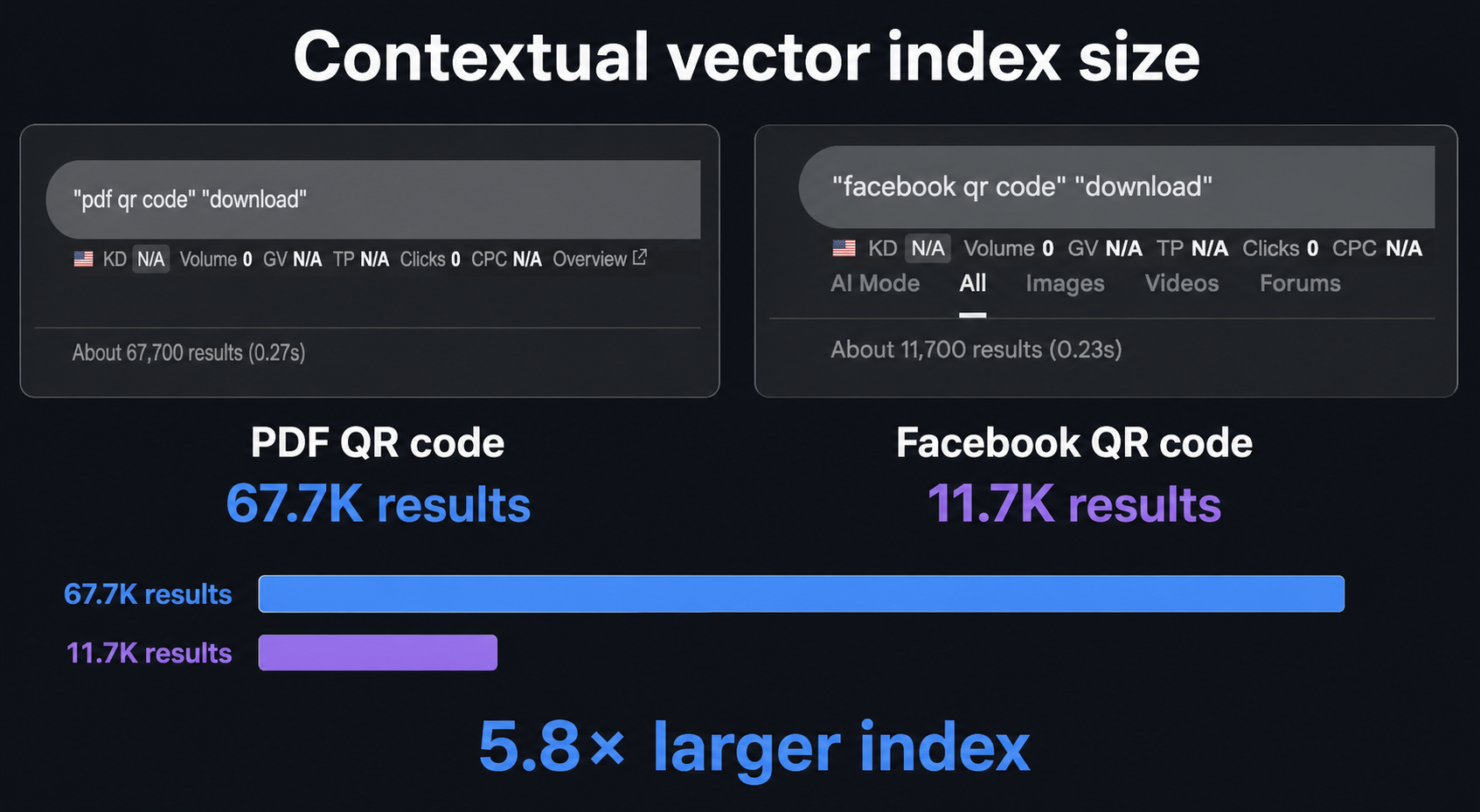
Each rating question, together with its historic click on and impression knowledge from net search or generative AI search outcomes, will increase the rating possibilities of the opposite variations in the identical question template.

Earlier, I defined my Question Deserves a Web page precept, which decreases the price of retrieval and will increase the rating alerts per net doc.
In response to this precept, we open a brand new web page provided that the question’s search demand exceeds a threshold and the question entails a distinct entity or a distinct sample that has low semantic similarity to the prevailing pages.
In different phrases, question templates assist Google classify the online quicker and select a single web site to fulfill extra queries from the identical subject or the identical template.
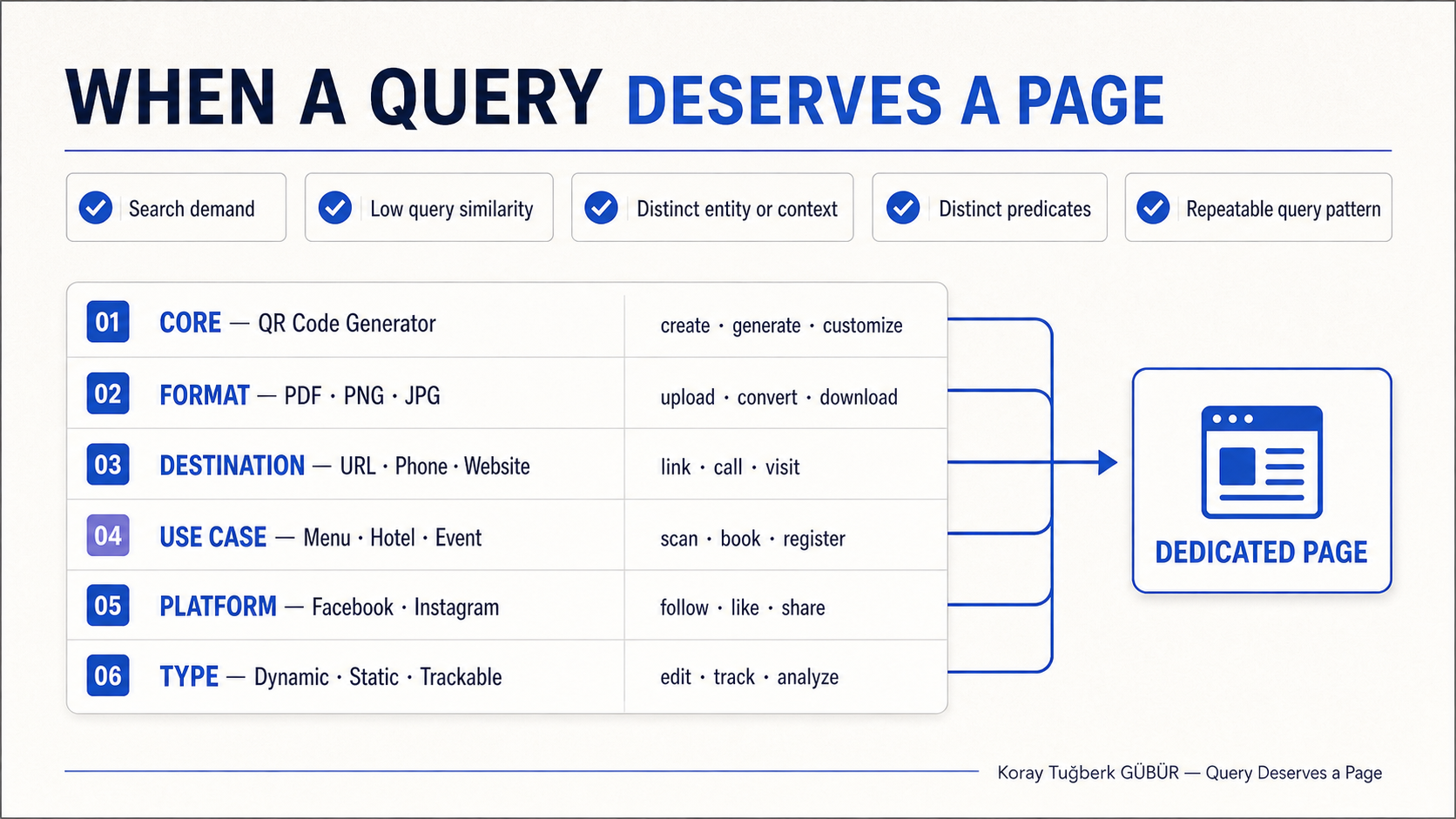
The Question Deserves a Web page precept is utilized to question templates with an identical mindset by grouping the predicates that can be utilized with the precise entity in every question group.
- If the predicates of a particular question template variation differ from the predicates of the others, it’s often a sign to open a brand new web page.
- If the predicates are extremely comparable however the entities within the question variations are totally different, it ought to nonetheless be a separate web page.
That’s why we use the micro- and macrosemantics ideas to distinguish textual and visible semantics optimizations from one another on a relevance degree.
For instance, “QR Code Generator for Fb” associated SERP candidates all the time have the identical performance, with very comparable layouts and annotations. The distinction within the inside components comes from the micro-differences.
Google’s “Figuring out Person Intent from Question Patterns” patent consists of situations of adjusting relevance and rankings from the small variations within the paperwork or question interpretations.
To elucidate microsemantics, I often use a easy instance. Examine the 2 sentences beneath.
- Monetary independence is achieved by households with the assistance of economic advisors.
- Monetary advisors assist households obtain monetary independence.
Each sentences state the identical truth, however relying on the question community I’m focusing on, their relevance scores will differ considerably. Micro variations in phrase order and within the dependency tree create relevance variations in precisely this fashion, and these micro variations are what I name microsemantics.
If the question has “monetary advisor” as the topic, your sentence must also have it as the topic. If “monetary independence” carries extra weight within the queries, then “monetary independence” ought to sit within the topic place of your semantic triples.
A triple is just the “topic, predicate, object” order of a press release. Matching the question augmentation fashions with the declarative details you host in your net paperwork is a microsemantic enchancment that maximizes your relevance.
It seems like a small enchancment, however when you’re attempting to rank for a question template with 3,000 variations, that small distinction is multiplied by 3,000 and turns into a serious rating issue.
Query augmentation is an idea I defined in our previous case study, which comes from Anand Shukla’s design, and it’s a direct equal to what Google calls “question fan-out.”
How Google augments a question time period impacts the “relevance weight” of a time period in a question and the way it’s best to construction your sentences.
Sentential, or sentence-level, semantics are a part of “microsemantics” to extend relevance in a marginal solution to be a foremost candidate doc for a complete question community.
Under is the “Query Suggestions Templates” anatomy for a similar “query-template” scoring and rating.

Bill Slawski’s last article was about “Generating Query Answers.”
The patent design right here explains that sure question templates require sure reply templates, and the search engine was searching for paperwork which have these templated solutions in a greater formatted solution to lower the price and enhance the standard and effectivity of index development.

If there’s a question template equivalent to “When is [entity] born,” Google seems for reply annotations to categorise a web page as helpful or non-useful, and it eliminates the non-useful sources quicker.
Ask your self this query: “What sort of visible or textual template does Google search for in my business?” to judge my doc community as environment friendly or expensive.
Google refers to those semantic situations as constraints. When a doc satisfies these constraints, it’s thought-about template-efficient.
If you happen to’re focusing on a particular question template, your content material ought to be structured with template-efficient sentence patterns supported by robust microsemantic relationships.
The following instance mission will discover this idea in larger depth and display how these constraints will be utilized in observe.
Question templates for rehabilitation for example
Whenever you rank a comparatively weaker model when it comes to funds, historic knowledge, PageRank, and branding, you want stronger historic click on knowledge to persuade engines like google to belief your net entity. Thus, within the rehab business, it’s often higher to go after two foremost templates:
- Does [entity] make habit
- Can I [drink/eat] [entity] [with, after, during, before] [entity]
These two question templates are wealthy sufficient to build up a excessive quantity of historic knowledge. Each click on, impression, and search engagement, together with LLM-feeding engagement, makes the online entity extra authoritative and reliable for the opposite question variations.
That is the principle area of the mission that targets these two particular question templates.

The Semrush outcomes for a similar mission embody the Google Enterprise Profile rating advantages on the identical time, in contrast to Search Console-only outcomes.

Under is the ‘Extension Area’ mission’s first-month outcomes with the identical semantic content material community that targets the identical question templates with the identical reply templates and semantic constraints.

The “habit sorts” entity class has greater than 30 entities as members, and each habit sort entity carries sub-relations to substances, habits, remedy methodologies, withdrawal signs, causes, threat components, and remedy durations.
Overlaying every member of the entity class with the identical set of attributes and sub-relations is what turns particular person pages right into a topical map, and it’s the entity-attribute path to topical authority that I described at first of this case research.
To implement the Question Deserves a Web page precept for the 2 foremost question templates, “does [substance] trigger habit” and “can I take [substance] with [substance],” we extract the attributes to cowl and join them again to the “[addiction type] rehab in [locale]” core pages in each micro and macro contexts by inside hyperlinks between the associated net paperwork.
This connection works in each instructions. Each time an informational templated web page ranks increased, the industrial touchdown web page linked to it additionally ranks higher.
This diagram explains how these question template variations contribute to the rankings of the industrial pages for locale-specific queries.

Get the publication search entrepreneurs depend on.
Structuring core and outer topical map sections round question templates
The core part and the outer part are the 2 foremost components of a topical map. Inner hyperlinks all the time move from the outer part towards the core part to switch rating alerts.
- The core part is usually industrial, and it carries an important ideas and entities.
- The outer part is usually informational, and it bridges the central entity to the opposite foremost entities of the topical map.
The third mission operates within the phrase video games business and ranks primarily for the “unscramble [word]” question template.

We all the time lower the price of retrieval by:
- Eradicating pointless pages by the Question Deserves a Web page precept.
- Fixing the technical website positioning issues that dilute rating alerts, which will increase the rating sign per net doc.
The primary problem within the phrase sport business is that each web site carries the identical info.
The outcomes for the “unscramble carry” question are all the time an identical throughout websites, so it’s important for us to implement visible and textual microsemantics higher than the competitors, growing the relevance per doc sufficient to compete towards 1.82 million outcomes.
Relating to the core and outer sections of the topical map, the “unscramble” business requires a programmatic website positioning strategy. In consequence, the core part will not be divided into industrial and informational. It’s divided into “commonest and widespread phrases” and “much less widespread phrases to unscramble.”
The 1,000 most vital phrases with evergreen search demand obtain the vast majority of the inner hyperlinks, are linked straight from the homepage, and supply extra distinctive info than the opponents at a less expensive value of retrieval.
To construction a lot of these initiatives, utilizing BigQuery is a should as a result of Google Search Console loses practically 40% of the query-based click on and impression knowledge by k-anonymization.
Right here’s a programmatic command for checking indexing and question efficiency.

One other helpful examine is a “crawls and clicks” efficiency comparability, which exhibits the place Googlebot spends its crawl exercise and the place the clicks and impressions are literally generated.
Under is an instance of a discrepancy from one other instance mission. The location receives an enormous share of its crawl exercise on tech and asset URLs, however these URLs don’t generate any clicks.
Usually, this crawl quota ought to be allotted to the sections that matter for historic click-satisfaction alerts. For this reason topical authority is all the time strictly linked to the technical facet of search engine communication.

The examples beneath come from a number of initiatives, together with the 13 web sites coated within the earlier website positioning case research and a number of other new websites included on this article.
Instance 1 for core, outer and question templates
The mission beneath is especially about social media advertising and marketing and promotion, and it has 5 foremost question templates.
- [Social media platform] + promotion
- [Social media platform] + engagement metrics
- [Social media platform] + influencers
- [Social media platform] + progress
- [Social media platform] + guides
Throughout all of those templates, some platforms deserve their very own web page, whereas others deserve solely a bit or a sentence.
Nevertheless, if a question community incorporates a Boolean query or an specific query question, it’s often higher to show it right into a web page for your entire community as a part of the outer part.
These query pages are useful for incomes the primary LLM approvals for generative AI search engagement, together with semantics-related SERP options equivalent to Folks Additionally Ask and Featured Snippets.
On this case, a template like “does [social media platform] pay for [engagement type]” is a helpful question template to leverage for transferring rating alerts additional into the core part of the topical map.
Under are the outcomes of the principle area and its extension area. These domains, MoreThanPanel and StreamingMafia, have been defined within the context of visual semantics in our first case research.

Instance 2 for core, outer, and question templates
The identical logic additionally works for tourism and journey enterprises equivalent to ETSTur and Ucuzabilet, with question templates like:
- “Historic websites in [city]”
- “Trekking routes in [city]”
- “Accommodations in [city]”
- “Grownup inns in [city]”
- “High eating places in [city]”
- “High museums in [city]”
- “High church buildings in [city]”
- And extra.
Since one among these websites is for inns and the opposite is for flight tickets, they share the identical outer part of the topical map, differing solely in contextual vectors and micro contexts.
A contextual vector is the order of headings and web page segments that flows the context from one subject to a different. One web site directs the context towards “the place to remain,” whereas the opposite directs it towards “when to go to” and “how one can get there,” whether or not by reserving a flight or bus ticket or renting a automobile.

Technically, the micro context is the illustration of the outer topical map inside the identical net doc. The macro context, wherever it seems, largely helps the contextual relevance towards the core part of the topical map.
All of those route, vacation spot, resort, vacation, and metropolis question networks are tied to one another by entity-attribute pairs and question templates, along with all of their variations.
Right here’s a illustration of the hotel-related and transportation-related outer sections of the 2 topical maps and the way each comply with the identical logic.

With the identical logic, you may see the tourism-focused web site’s outcomes beneath.

Instance 3 for core, outer, and question templates
The web site right here belongs to one of many greatest internet hosting firms, and the core and outer sections of its topical map shifted to new topics by totally different question templates.
Since “web site builder” and “AI web site generator” instruments have turn into a serious supply of demand within the business, the core and outer sections of the topical map needed to change accordingly.

The outcomes whereas migrating the topical map’s core from internet hosting to the web site builder.
The core part moved from “internet hosting for [industry]” to “[industry] web site builder,” whereas “[industry] web site templates” and “how one can open a [industry] enterprise” turned the principle outer part topics.
Relying on search demand, the outer part can prolong into additional question templates equivalent to “[industry] web site examples,” “[industry] web site headers,” “footers,” “about pages,” “sign-in pages,” “product pages,” and “pop-up concepts.”
All of those queries and web page template pairs ultimately hyperlink again to the core part to switch their rating alerts, precisely as within the first examples.

Instance 4 for core, outer, and question templates
The corporate right here is an ecommerce firm specializing in rave tradition and clothes. It’s additionally a case research mission we didn’t give earlier.
The mission’s core part is straight associated to the [gender] [rave] [clothe/dress/top/crop/bottom]-like class question templates, whereas the outer part primarily focuses on the “festivals” with two foremost templates.
- Competition + Guidelines
- Competition + Outfit concepts
We largely hold these pages additionally industrial, even when they’re outer sections of the topical map. Informational paperwork ought to be commercially associated as a lot as attainable by offering direct conversion parts on the highest of the web page.
Even when we offer guidelines objects or outfit concepts, we merge these with our merchandise by commercializing the informational paperwork.

This brings us to the 4 foremost rules we apply to semantics: visualization, verbalization, commercialization, and contextualization.
Everytime you commercialize a doc and web site, you’ve gotten a better probability of rating in Google’s post-helpful content material system updates, which favors purposeful web sites with concrete and distinctive providers and advantages, reasonably than simply content material websites.

Right here’s a case research spanning two and a half years. A semantic content material community that didn’t rank whereas it was hosted on an affiliate web site started rating higher once we moved it to a industrial web site, with precisely the identical content material and context.

You may observe how rating alerts are created within the outer part of the topical map and transferred to the predominantly industrial core by query-template variations.
Each click on, impression, consumer interplay, or LLM grounding generated by the outer part reinforces the contextual relevance and rating alerts of the industrial pages by the inner linking structure.

The ultimate level is that each new supporting doc you publish creates extra contextual anchors for the core pages in your topical map.
As these paperwork broaden the inner linking ecosystem, they introduce contemporary anchor contexts that reinforce topical relevance, contribute to content material freshness, and supply extra rating justification by Google’s anchor tag indexing system.
In our system, we keep away from repeating the identical anchor textual content greater than thrice inside the principle content material. This helps protect anchor variety, strengthen contextual uniqueness, and supply clearer originality alerts throughout the inner linking construction.
Instance 5 for core, outer and question templates
Will we all the time should cowl these question templates by opening new pages? Definitely not. A topical map, and even a complete semantic content material community, will be precisely one web page.
Under is an instance from our first case research, which covers all the question template variations listed as a single web page.
Most of those variations don’t even seem within the headings, but the web page nonetheless penetrates all of those queries higher than different websites. The primary causes for this are visible semantics, optimistic historic click on knowledge, and the upper relevance weight that comes from having fewer phrases on the web page.

Among the foremost question templates coated as a single web page, regardless of different websites doing the identical with a number of net paperwork, embody:
- MP4 to textual content.
- MP3 to textual content.
- Video to textual content.
- Audio to textual content.
- WAV to textual content.
This graph exhibits extra variations.

Own the conversation before your competitors.
See where your brand appears, where it doesn’t, and exactly how to win more visibility across search, AI, local, social, and every channel that matters.
Start your free trial
Question templates require consistency and uniqueness
Overlaying extra attributes than your opponents or extra question template variations than anybody else doesn’t assure higher rankings.
website positioning is a posh adaptive system, and Google regularly assessments web sites on the SERP to find out whether or not they fulfill customers. Broad Core Algorithm updates typically set off these re-rankings.
NavBoost is likely one of the most vital rating ideas in immediately’s website positioning as a result of it combines clicks, topicality, and PageRank as a hybrid rating issue. The RankLab module explains these click on assessments in larger element.
The Automatic Query Pattern Generation patent explains how Google generates new question templates and constructs indexes.

Google depends on patterns as a result of pattern-based rating solves issues quicker. Paul Haahr of Google defined this throughout his “Improving the Search over Years” speech:
- “If there’s a question with incorrect outcomes, we received’t repair it. If this question belongs to a cluster, we’ll repair it. We’re not interested by particular person SERPs even when we all know that it’s incorrect.”
Contributing authors are invited to create content material for Search Engine Land and are chosen for his or her experience and contribution to the search neighborhood. Our contributors work underneath the oversight of the editorial staff and contributions are checked for high quality and relevance to our readers. Search Engine Land is owned by Semrush. Contributor was not requested to make any direct or oblique mentions of Semrush. The opinions they specific are their very own.
#Question #templates #Increasing #scope #topical #authority
