
Social Signals
Why proprietary data is your most defensible AI citation asset

Jul

Publish authentic numbers. It’s the one most dependable lever for making a web page extra authentic, and essentially the most defensible numbers are a byproduct of the enterprise itself… not information you assembled to feed a content material calendar.
The previous play was paying a PR or analysis agency for a survey loosely tied to your product, like a automobile insurance coverage FinTech shopping for road-trip analysis to land in Yahoo. That’s outdated. Virtually each product now generates information price publishing, and pulling it has by no means been simpler.
You don’t want a analysis crew. The bar to clear the sector is decrease than you assume.
First-party information: The strongest correlation of originality
On-Web page.ai’s latest information gain study scored 150 top-3 Google pages throughout 50 key phrases and 10 verticals on how a lot every provides past the remainder of its rating cohort, grading the contribution from 0 to 100 by that means moderately than wording.
The median web page scored 52, and authentic information correlated with that rating greater than every other page-level trait, together with size.
Pages with at most 1 distinctive determine averaged an data achieve rating of 40.2, whereas pages with 15 or extra averaged 62.1, and the rating climbed steadily at each step in between
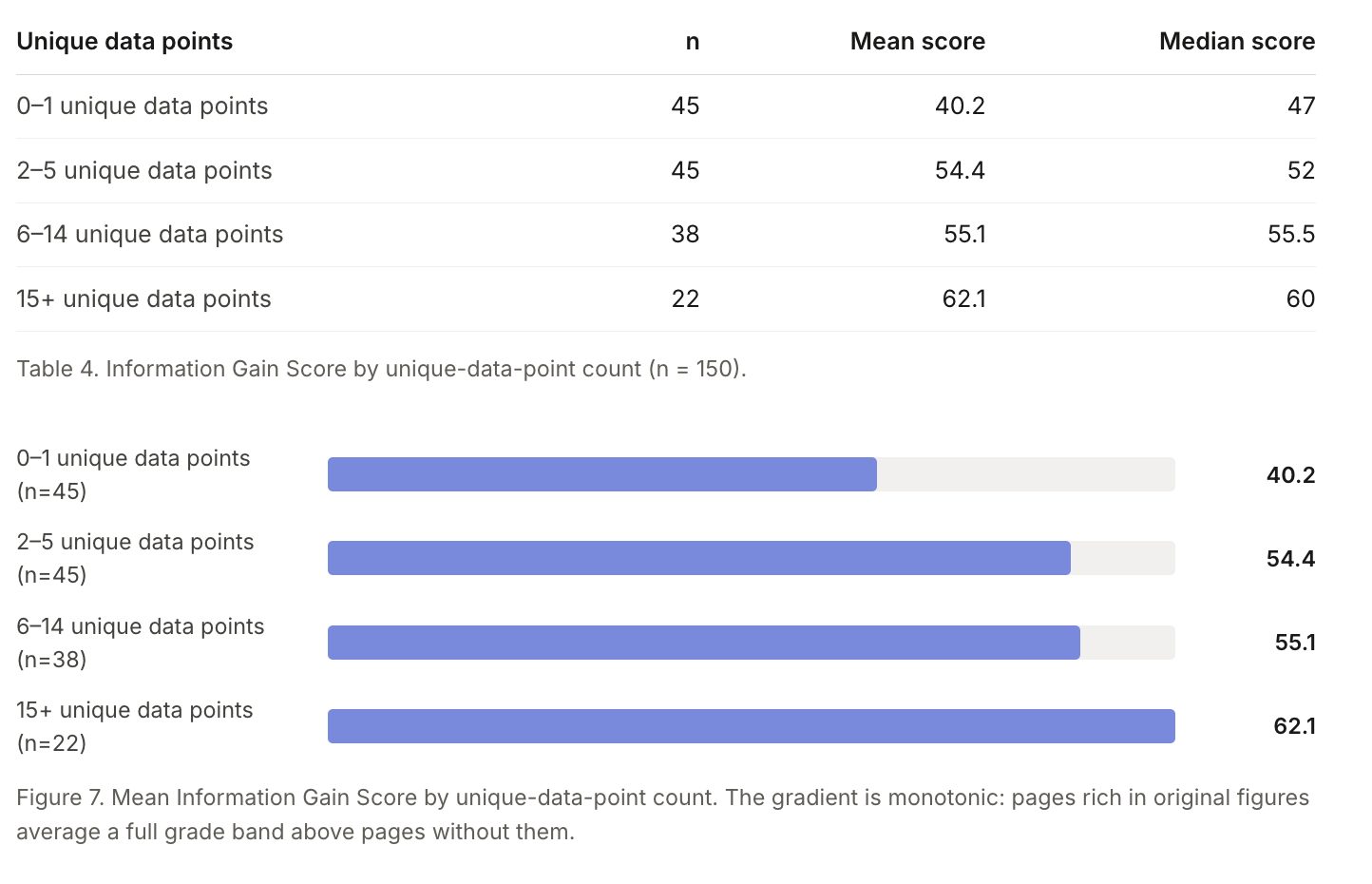
Excellent news, the bar to beat is low. The examine discovered that it may not take a lot authentic proof to outclass top-visible pages in basic Google search: high natural outcomes usually have solely 4 distinctive information factors on common. Publish a web page that features greater than 4 actual authentic claims, figures, or solutions, and that’s yet one more lever to drag for more and more aggressive natural visibility.
This evaluation additionally discovered that in nearly each search, there are many adjoining unanswered questions which are being left on the desk. On-Web page ran their evaluation with artificial reader questions, a pattern of believable questions generated for the examine, that had been a carefully associated set to the search matter of every question, and outcomes confirmed an open door for brand new pages to reply them and stand out. (Remind you of something? Query fan-out, maybe?)
We had an identical discovering in an evaluation of ChatGPT citations:
“A single evergreen web page overlaying 10+ question intents is price extra in AI quotation attain than 10 single-intent pages. The ROI of complete content material is front-loaded: one well-built web page compounds quotation attain over time. The lengthy tail exists, however the high 5% of pages seize a disproportionate share of ongoing quotation exercise.” – The science of how AI picks its sources
In reality, your model’s high-intent prompts needs to be monitored throughout a journey for this function. Flip them into journeys that observe the customer throughout the 5 levels from Reasoning Lift: Downside, Exploration, Comparability, Validation, Choice. (Learn extra about more accurate AI prompt tracking right here.) Reply these questions on the web page with the data and experience that solely your model can to remain aggressive towards this discovering within the evaluation.
The principle takeaway from the findings: Most pages are middling on originality, genuinely authentic pages are a minority, and scoring excessive sufficient to face out is achievable… with out being a unprecedented feat or raise.
The hole within the findings? This examine focuses on basic search visibility and rankings (the search engine optimization idea of data achieve was born out of a Google patent language, in spite of everything). It doesn’t take AI citations or mentions into consideration, and there’s no point out of together with AI Mode or AI Overviews within the evaluation.
Caveat: Being the first supply might not win the quotation
That is the half most proprietary data-publishing recommendation skips. Everybody says publish authentic analysis. Few check whether or not AI rewards the model that originated the quantity or the web page that presents it most readably.
Extra information evaluation is coming subsequent week, however what we do know from analyses we’ve accomplished at Development Memo this final 12 months:
- The entity varieties that predict ChatGPT citations essentially the most are DATE and NUMBER (from The science of what AI actually rewards). Excessive-cited pages are dense with particular entities: a specific methodology, a exact statistic, a named comparability. Even when your proprietary findings are picked up by one other supply that’s cited as a substitute, these exterior third-party authority alerts are more likely to construct.
- Entity-richness and balanced sentiment matter (from The science of how AI pays attention). Generic recommendation is dangerous and imprecise, however particular entities are grounded and verifiable. Proprietary information produces, verifies, or validates and creates entity-rich content material. (Suppose: why a characteristic works to save lots of % of {dollars}, what number of hours saved by shoppers vs. opponents they labored with earlier than, and many others.). Add balanced sentiment into the evaluation and clarification of your information, and also you’ve acquired your self a 2-for-1 tactic.
If the speculation that first-party information is essential within the period of AI search holds, publishing content material primarily based on proprietary information is important…, however it isn’t enough. LLM extraction construction (together with the websites that AI search engines like google belief for the subject) decides who will get the quotation, even when your model owns the information.
Sadly, an aggregator who repackages your benchmark right into a cleaner answer-ready web page can gather the quotation your analysis earned. (Fact sucks.)
- Who wins: Manufacturers sitting on proprietary product, utilization, or pricing information who additionally construction it for extraction and don’t ignore different natural model authority constructing performs. (Be taught extra in How to build an AI SEO strategy that outlasts tactics.)
- Who loses: Manufacturers producing opinion content material any device can replicate, ignore different essential methods of constructing off-site authority, together with main sources who bury their very own numbers in narrative as a substitute of surfacing them.
Whether or not some verticals reward information content material greater than others, we have no idea but. The science series discovered quotation alerts differ sharply by vertical, so a uniform payoff can be the shock, however we is not going to assert a sample with out information.
Proudly owning the information will get you into the battle for visibility. However the way you construction your content material might be what wins it.
We analyzed 18,012 verified ChatGPT citations and located a ski-ramp distribution: 44.2% of all citations come from the primary 30% of a web page. The center 30-70% earns 31.1%, and content material buried deep in an extended put up is roughly 2.5x much less more likely to be cited.
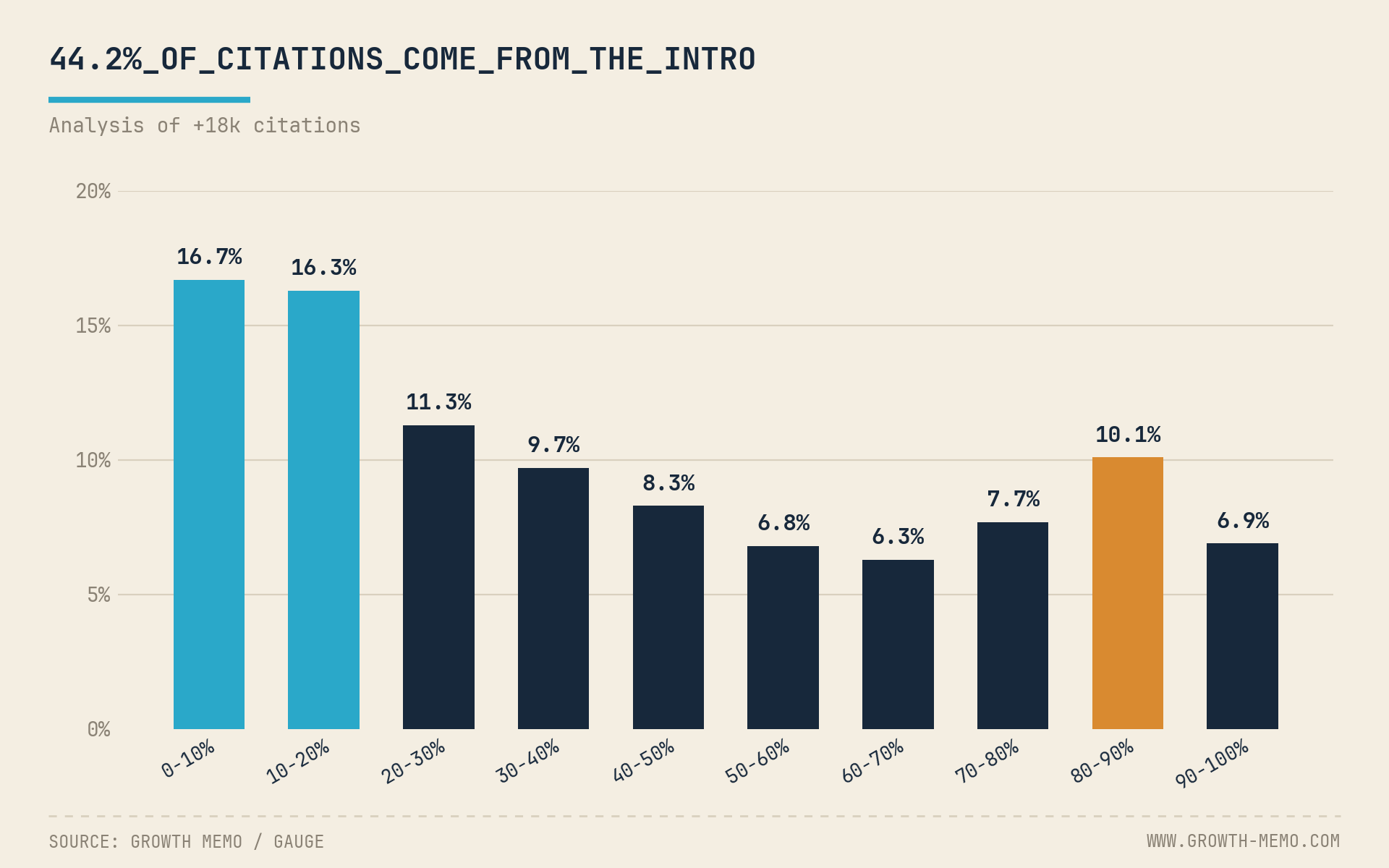
The follow-up analysis across 7 verticals sharpened the goal: The ten-20% band of a web page is the place AI reads hardest in each vertical, whereas the primary 10% is often navigation and intro filler that AI skips. The underside 10% of any web page earns 2.4-4.4% of citations no matter vertical.

Utilized to an information examine, the construction of your content material writes itself:
- Lead with the headline statistic. Your strongest quantity goes within the first 30% of the web page, ideally proper after the title block the place the 10-20% band begins. Quantity → comparability → implication, within the first display screen.
- Outline the metric instantly. One sentence on what the quantity measures and the inhabitants it covers. An undefined statistic is tougher to raise with confidence
- Field the methodology. Pattern measurement, time window, assortment methodology, in a brief labeled block. Attribution confidence is a part of what makes a quantity citable.
- Entrance-load each secondary discovering. Findings ranked by energy, strongest first. The 20-paragraph narrative buildup is a human-retention sample that prices you machine citations.
- Skip the suspense shut. AI reads like a busy editor, not a affected person scholar. [source] The payoff-at-the-end construction that labored for final guides actively works towards extraction.
This put up first appeared on the creator’s web site and is republished right here with permission.
Contributing authors are invited to create content material for Search Engine Land and are chosen for his or her experience and contribution to the search group. Our contributors work underneath the oversight of the editorial staff and contributions are checked for high quality and relevance to our readers. Search Engine Land is owned by Semrush. Contributor was not requested to make any direct or oblique mentions of Semrush. The opinions they categorical are their very own.
#proprietary #information #defensible #quotation #asset
