
Social Signals
3 ways to build a more complete SEO ROI model

Jun

SEO attribution has all the time been messy. Not like paid search, natural search lacks the identical monitoring granularity, has a lag between the work and the outcomes, and infrequently is dependent upon alerts you’ll be able to’t management, resembling rankings.
To make issues worse, attribution is much more of a black field in the present day, with AI-generated solutions dominating SERPs and LLMs that don’t all the time hyperlink again to your web site or go referrer strings.
Companies have by no means actually cared about that complexity. They care concerning the return they’re getting from their advertising {dollars}.
The excellent news?
SEOs can nonetheless inform a compelling ROI story, but it surely takes extra nuance, extra knowledge digging, and extra math than ever earlier than. This text walks by way of key concerns as you construct your subsequent Search engine optimisation ROI story.
The historic system for calculating ROI
Search engine optimisation ROI has historically been calculated utilizing variations of the identical system:
- ROI = ((Incremental natural income − Search engine optimisation prices) / Search engine optimisation prices) x 100
It’s clear, matches on a single slide for executives, and is sensible for a very long time. Earlier than the rise of generative AI, driving incremental visitors — and due to this fact income — was the north star for many Search engine optimisation campaigns.
Nonetheless, sharp will increase in zero-click searches and main attribution gaps from LLMs have upended conventional fashions.
In lots of circumstances, natural visitors could also be flat and even declining, whilst total visibility will increase by way of impressions, AI Overview rankings, or immediate visibility.
Wanting solely at natural metrics and incremental positive factors tells solely a part of the story. To indicate Search engine optimisation’s true worth, we have to rethink the system.
Be the brand customers find first.
Track, grow, and measure your visibility across Google, AI search, social, local, and every channel that influences buying decisions.
Start your free trial
Listed here are 3 ways to construct a extra full Search engine optimisation ROI mannequin.
1. Take credit score for all natural income, not simply incremental positive factors
With 60% of searches ending with no click on, and that quantity persevering with to develop, an enormous a part of Search engine optimisation’s worth in the present day is defensive. Meaning maintaining and protecting traffic that will in any other case erode resulting from varied components.
The system above doesn’t account for that in any respect. For instance, would you choose a goalkeeper’s efficiency by what number of targets they’ve scored?
The identical is more and more true of Search engine optimisation. Solely counting what’s new erases the whole lot you preserved.
In a flat or declining panorama, holding the road is a serious win, but it’s fully ignored while you focus solely on incremental positive factors.
The start line for this ROI story shouldn’t be incremental natural income alone. It must be all natural income. That’s the whole asset Search engine optimisation is accountable for sustaining and defending.
This can be a troublesome promote for a lot of web site homeowners, but it surely’s the reality. And in case you go this route, there’s one main caveat.
Phase out model vs. non-brand clicks
Claiming all natural income is disingenuous if branded progress is driving a lot of the efficiency.
Branded visitors is influenced by many components exterior Search engine optimisation’s management, together with PR campaigns, paid media, product, phrase of mouth, and extra. When somebody Googles your web site by identify, Search engine optimisation hardly ever created that demand. It merely captured it.
Search engine optimisation’s actual lever is non-branded search. Earlier than taking credit score for whole natural income, it’s good to section it accordingly.
Since this could’t be achieved cleanly in Google Analytics, begin by pulling the branded-versus-non-branded break up from Google Search Console. Then apply that break up to your whole natural income utilizing a weighted mannequin.
Right here’s some real-world knowledge, for instance:
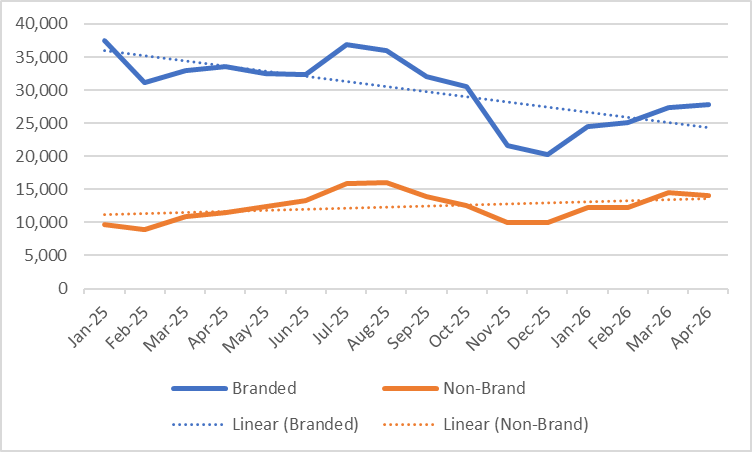
Branded visitors accounts for about 70% of whole clicks and is declining, whereas non-brand visitors accounts for roughly 30% and is rising. That break up tells a worth story by itself as a result of non-branded progress offsetting branded decline is strictly what good Search engine optimisation ought to produce. Earlier than taking credit score for whole natural income, although, we have to create a blended weight.
Let’s say Search engine optimisation will get 10% credit score for branded visitors and 100% credit score for non-branded visitors. Deal with these as beginning factors and calibrate them for every shopper. The calculation could be:
- (70% model x 10% weight) + (30% non-brand x 100% weight) = 7% + 30% = 37% blended attribution weight
Apply that 37% weight to whole natural income. If the positioning generates $100,000 in natural income monthly, Search engine optimisation will get credit score for $37,000, not the complete $100,000.
That’s doubtless far larger than the income you’d attribute to incremental positive factors alone. Since you’ve overtly discounted credit score you don’t deserve, the mannequin is extra defensible and exhibits stakeholders that you simply perceive its limitations.
Dig deeper: The dark SEO funnel: Why traffic no longer proves SEO success
2. Account for assisted conversions and first-click affect
Final-click attribution buries Search engine optimisation. That’s nothing new, but it surely’s much more related in the present day.
Natural is usually the primary touchpoint in a consumer’s journey. At this time, which may imply solely an impression, with no measurable click on in any respect.
Take away that affect, and Search engine optimisation can appear like a minor contributor to income it really initiated.
Search engine optimisation ought to take credit score for the conversions it assists, even when one other channel closes them. Right here’s an instance:

Natural dominates all three phases of touchpoint credit score, however a last-click-only mannequin rewards solely the ultimate click on.
The catch is that GA4 doesn’t floor a clear assisted-conversion worth the way in which Common Analytics did. Exactly calculating assisted conversions requires exporting path knowledge to BigQuery and deriving a real fractional worth for every channel.
Nonetheless, data-driven attribution in GA4 offers a defensible shortcut. Google already assigns every channel fractional credit score primarily based on its affect on conversions. We will use natural’s early- and mid-touch credit score as a proxy for the help worth that last-click attribution ignores.
- 1,345.69 (early) + 687.34 (mid) = 2,033.03 in conversion credit score
From there, multiply by the worth of a conversion, utilizing $100 as an illustration.
- 2,033.03 x $100 (conversion worth) = $203,303
The identical brand-versus-non-brand logic technically applies to assists. Since GA4 doesn’t cleanly break up help credit score by question sort, we overlooked late-touch credit score. That’s the place branded habits tends to pay attention, and excluding it removes a lot of the credit score that will in any other case be discounted.
At the same time as a directional quantity, the info proves the purpose: Natural is offering actual worth. Counting on last-click attribution alone leaves that ROI out of your story.
Dig deeper: Stop paying for traffic: The enterprise CMO’s guide to ROI-driven SEO
3. Measure Search engine optimisation content material affect throughout different channels
Search engine optimisation-led content material doesn’t keep inside the natural channel. The identical analysis, briefs, and articles your crew produces might be repurposed throughout a number of channels:
Wanting solely at natural income ignores all of the downstream worth generated by Search engine optimisation efforts.
I just lately checked out a shopper the place we’d simply began publishing new articles and refreshing current ones. After just one month, we have been already seeing a few of that content material getting used and producing conversions in different channels.

Certain, 29 calls and 5 certified leads aren’t an enormous quantity. However it can develop over time, and people are conversions Search engine optimisation shouldn’t ignore.
Much like assisted conversions, drilling all the way down to an precise greenback quantity requires some fancy math, but it surely’s attainable.
Begin by:
- Discovering and cataloging which Search engine optimisation-led pages are used throughout completely different channels.
- Calculating the share of conversions generated by these Search engine optimisation-led pages.
- Making use of that share to the full conversion worth of every channel.
In observe, it may look one thing like this:
- 500 conversions (paid search) x $100 (conversion worth) x 5% (share of conversions from Search engine optimisation-led pages) = $2,500 in downstream worth
Even when the numbers really feel small, that is one other manner Search engine optimisation can rightfully declare income and assist justify the general value of the marketing campaign.
Dig deeper: What 4 AI search experiments reveal about attribution and buying decisions
Own the conversation before your competitors.
See where your brand appears, where it doesn’t, and exactly how to win more visibility across search, AI, local, social, and every channel that matters.
Start your free trial
The dos and don’ts of Search engine optimisation ROI
Search engine optimisation can and may take credit score for worth past incremental natural income. Your actual methodology could differ, so work along with your most data-savvy crew members to get it proper. The final ideas are what matter:
- Take credit score for all natural efficiency, however don’t take credit score for each branded click on as if Search engine optimisation created that demand.
- Take a look at assisted conversions and different attribution fashions. Don’t consider Search engine optimisation inside the natural silo alone.
- Take credit score when Search engine optimisation content material is utilized by different channels. Don’t ignore the downstream affect it may possibly have.
- Get inventive when fixing the ROI puzzle. Don’t let an outdated system undersell your work.
The traditional ROI system isn’t improper. It’s incomplete.
As search evolves, the way in which we measure ROI ought to evolve with it.
Contributing authors are invited to create content material for Search Engine Land and are chosen for his or her experience and contribution to the search neighborhood. Our contributors work underneath the oversight of the editorial staff and contributions are checked for high quality and relevance to our readers. Search Engine Land is owned by Semrush. Contributor was not requested to make any direct or oblique mentions of Semrush. The opinions they categorical are their very own.
#methods #construct #full #Search engine optimisation #ROI #mannequin
