
Social Signals
Where AI agents get stuck on your site

Jul

The following mass frontier of AI is agentic:
To determine how prepared B2B websites are for agentic guests, I teamed up with David Kaufman, founding father of Siteline, and I analyzed how brokers scan web sites and the place they get caught. The reply: most websites are agent-ready, however there’s one essential breaking level.
Brokers don’t learn web sites like people. They obtain a activity, search the net, fetch pages, extract details, and cite the sources they used. A web page can persuade a human and nonetheless fail an agent if the details are exhausting to search out (opacity), exhausting to fetch (machine-readability), or exhausting to quote (entry friction).
AI brokers flip web sites from showrooms into barcodes.
How we checked out agent conduct:
- The agent needed to discover the official web site itself. We didn’t present beginning hyperlinks, eg to homepages.
- We gave brokers three buyer-related duties for 100 B2B merchandise: discover pricing/options, integrations, and safety/compliance. We ran every activity 5 occasions to measure the impression of the probabilistic nature of LLMs.
- We weren’t evaluating whether or not or not the knowledge existed someplace on the net; as an alternative, we measured whether or not the agent might reliably reply from the seller’s personal web site.
1. Pricing breaks first-party websites
The second a prospect seems at pricing, they cease searching and begin evaluating. Excessive purchaser intent, backside of the funnel. That makes pricing the toughest and most essential take a look at of whether or not a vendor web site can serve brokers immediately.
Pricing additionally sits in a triangle of three “needs” that good pricing pages have to fulfill:
- Firms need to management pricing disclosure.
- Consumers need quick comparability.
- Brokers want clear, fetchable, citable details.
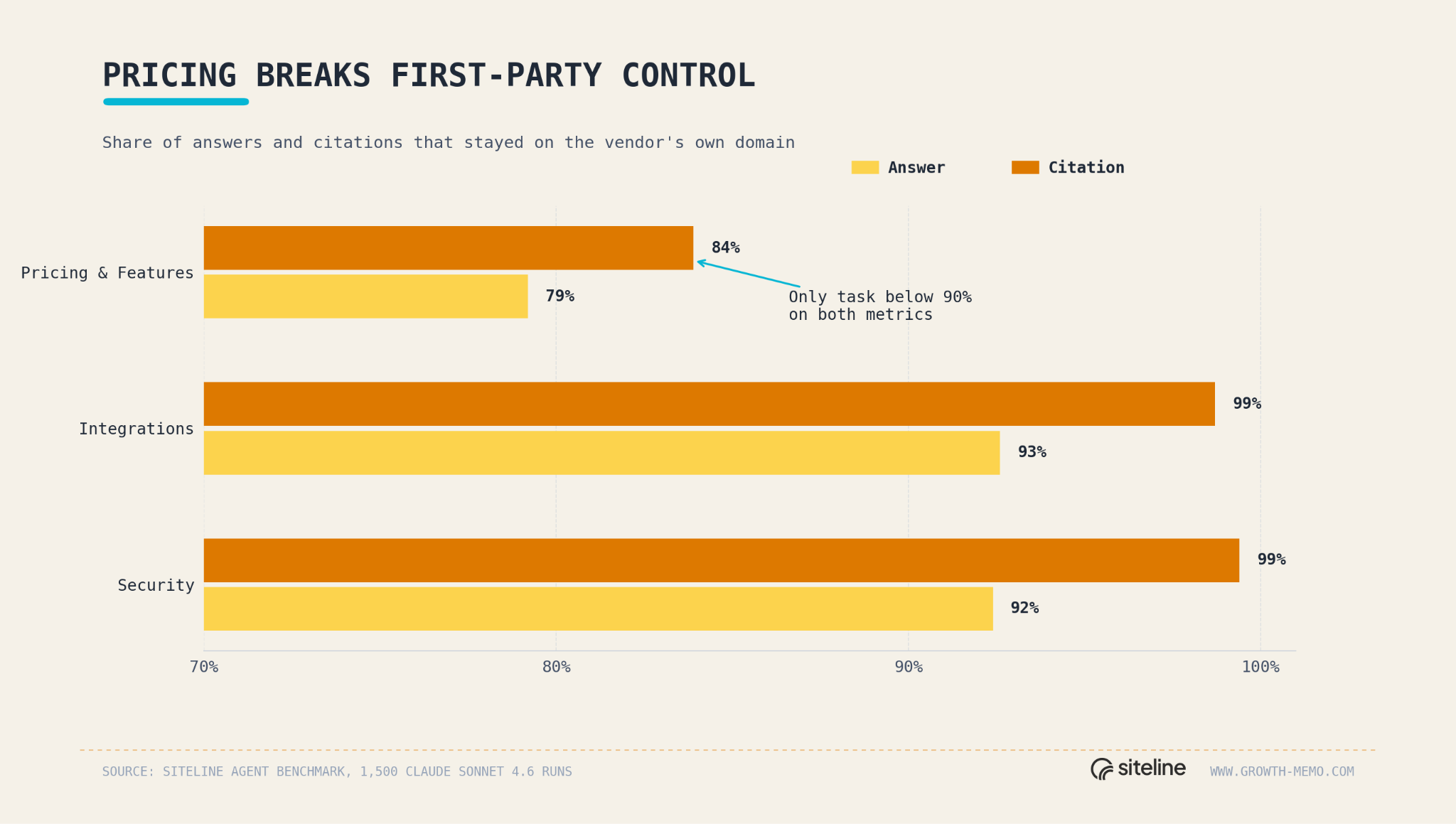
When AI brokers attempt to retrieve pricing, they get caught far more than for safety or integrations.
- Pricing/options: 79% first-party reply price, 84% first-party quotation share.
- Integrations: 93% and 99%.
- Safety: 92% and 99%.
- Pricing/options produced 77% of all third-party citations.
In the event you wonder if that’s as a result of some B2B firms don’t publicly present pricing, you’re solely half proper.
2. Hidden pricing is simply a part of it
Hiding costs forces brokers to look elsewhere, however revealed costs don’t absolutely resolve the issue. Amongst pricing immediate runs the place the seller didn’t disclose an actual value, 45% cited not less than one third-party supply. The opposite 55% stayed on first-party citations, normally by saying the seller required contact gross sales or didn’t publish a concrete value.
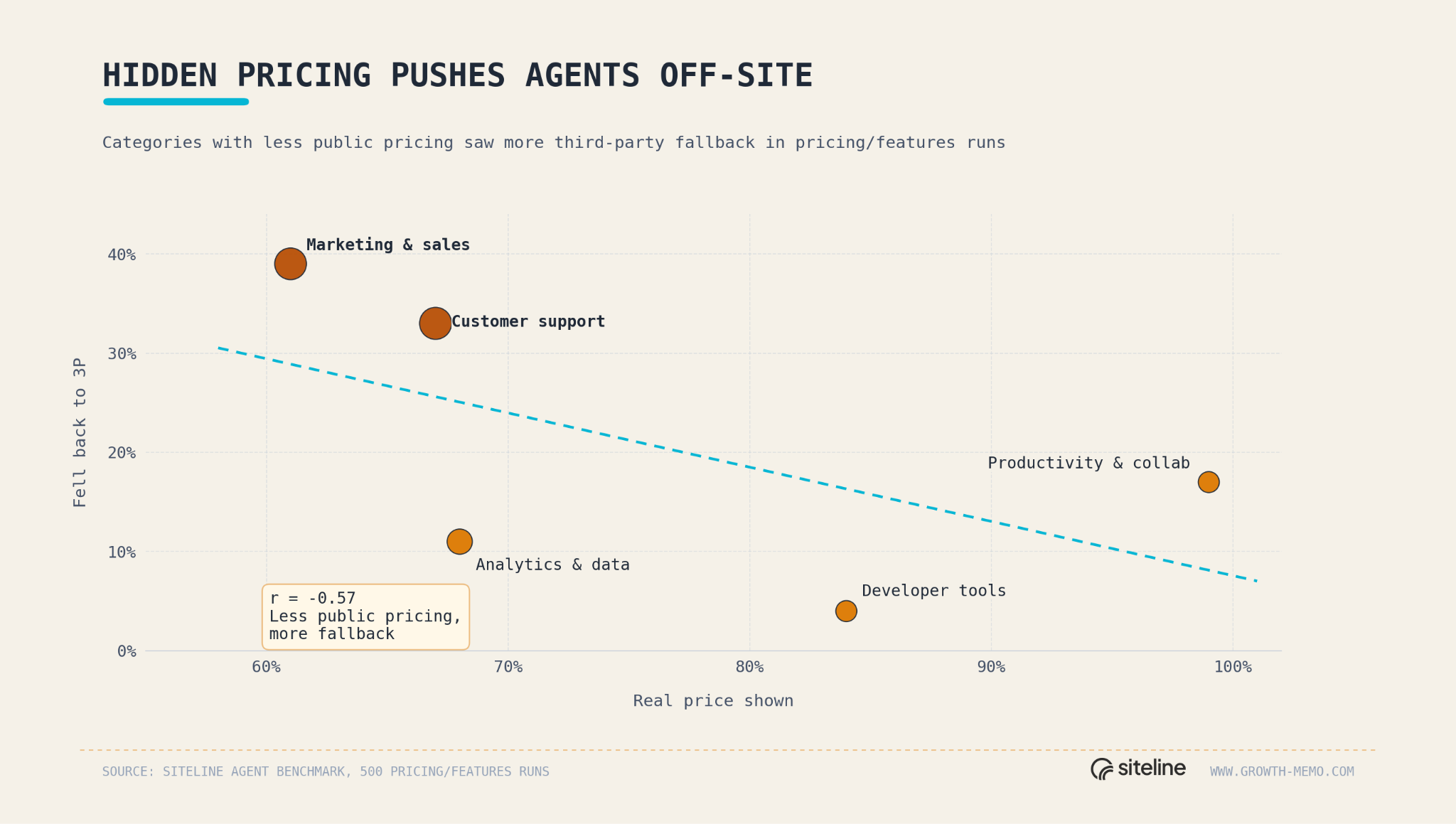
Even when the seller confirmed a numeric public value, brokers nonetheless cited not less than one third-party supply in 18% of runs, suggesting value will be on the web page however nonetheless be exhausting for the agent to extract, belief, or cite cleanly.
You’ll be able to attempt to conceal your pricing, however you higher be certain that nobody else is aware of and writes about it. As soon as it’s “on the market”, it’s too late. You probably have complicated pricing methodology, one of the best ways is to clarify it clearly and make it accessible to brokers.
Some pricing pages are seen to people however not dependable sufficient for brokers to parse and cite. You’ll be able to’t at all times belief your eyes.
3. Brokers fail for 3 causes
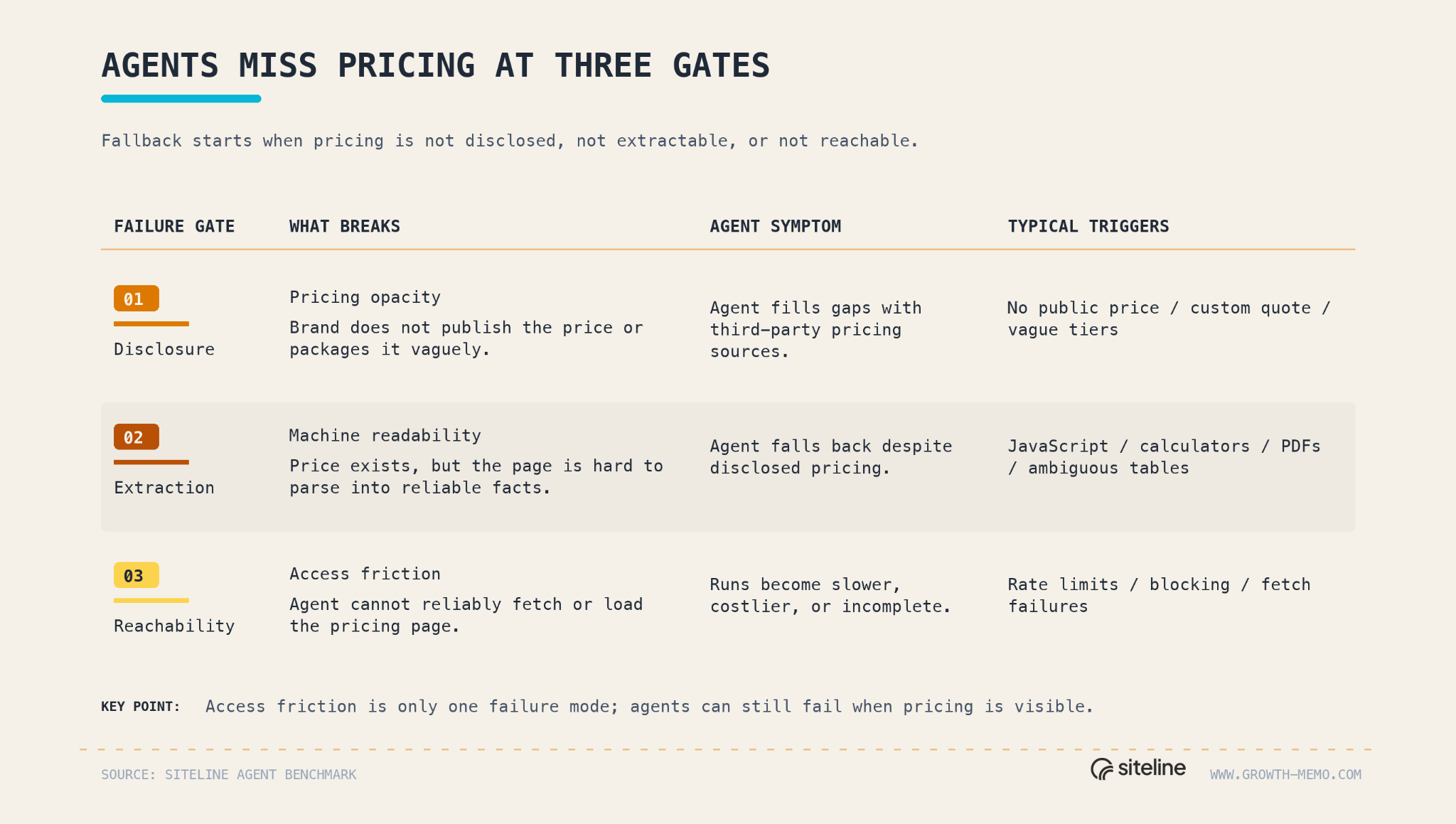
Brokers fail to retrieve pricing from a model for 3 causes: opacity, machine-readability, and entry friction.
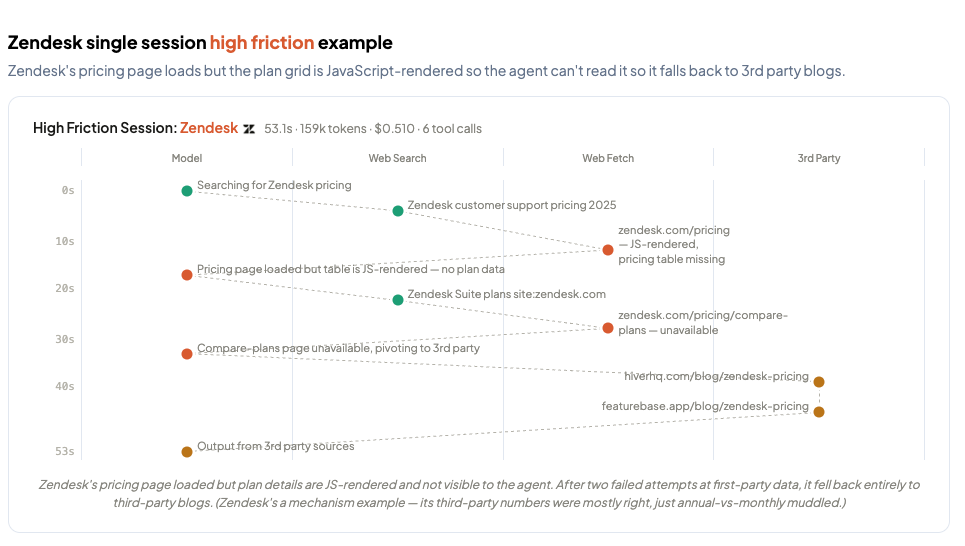
Instance of an agent struggling to retrieve Zendesk’s pricing and pivoting to third-party sources.
- Pricing opacity merely means the model doesn’t publicly disclose the worth, or it’s vaguely packaged. Opacity explains elevated fallback, which means brokers should depend on third events for data.
- Machine-readability describes the scenario when costs exist, however brokers nonetheless don’t confidently extract them. Machine-readability explains fallback regardless of disclosed pricing. Machine-readability fails when the worth is tough to extract due to web page construction, JavaScript, calculators, toggles, screenshots, PDFs, or ambiguous tables.
- Entry friction is what most individuals count on to be the issue with brokers. The agent hits fetch failures, price limits, blocking, or unreachable pages, making agent runs extra expensive.
Entry errors weren’t the principle motive brokers left first-party sources, however once they occurred, they have been extreme. They appeared in solely 7% of all runs. In pricing runs, entry errors pushed third-party fallback to 77%, in comparison with 17% with out entry errors.
The impression of errors on agent run value (tokens, internet searches, fetches, retrieves, time) is critical when evaluating the ninetieth with the tenth percentile in our examine:
- Price: 4.4x
- Token: 4.7x
- Time: 2.0x
Manufacturers don’t pay that invoice immediately, however it’s a helpful proxy for friction. The tougher your web site is to retrieve, the extra work an agent has to do earlier than it will possibly reply out of your web page. In case your pricing web page is blocked, gradual, exhausting to fetch, or exhausting to parse, the agent has two decisions: spend extra work in your web site… or get the reply elsewhere.
4. The fallback internet is messy
Fallback happens when brokers should depend on third-party sources reasonably than first-party sources because of the three failure modes. That is the largest threat as a result of third-party data is spotty and past your management.
Brokers don’t fall again to 1 clear supply class. They reconstruct pricing from a blended internet of explainers, directories, app shops, companion pages, and low-trust aggregators.

Key stats from the 580 pricing third-party citations:
- 52% have been editorial (blogs, media articles, comparability guides, explainers, and different article-style pages).
- 46% fell into the listing class (evaluation, procurement, and software-listing websites corresponding to G2, Capterra, Vendr, Tekpon, and related domains).
- 2% from broader ecosystem pages (app shops, marketplaces, companion pages, and integration directories tied to a different platform).
The examples present the chance of lacking pricing transparency and agent hindrances in your web site.

Instance journey:
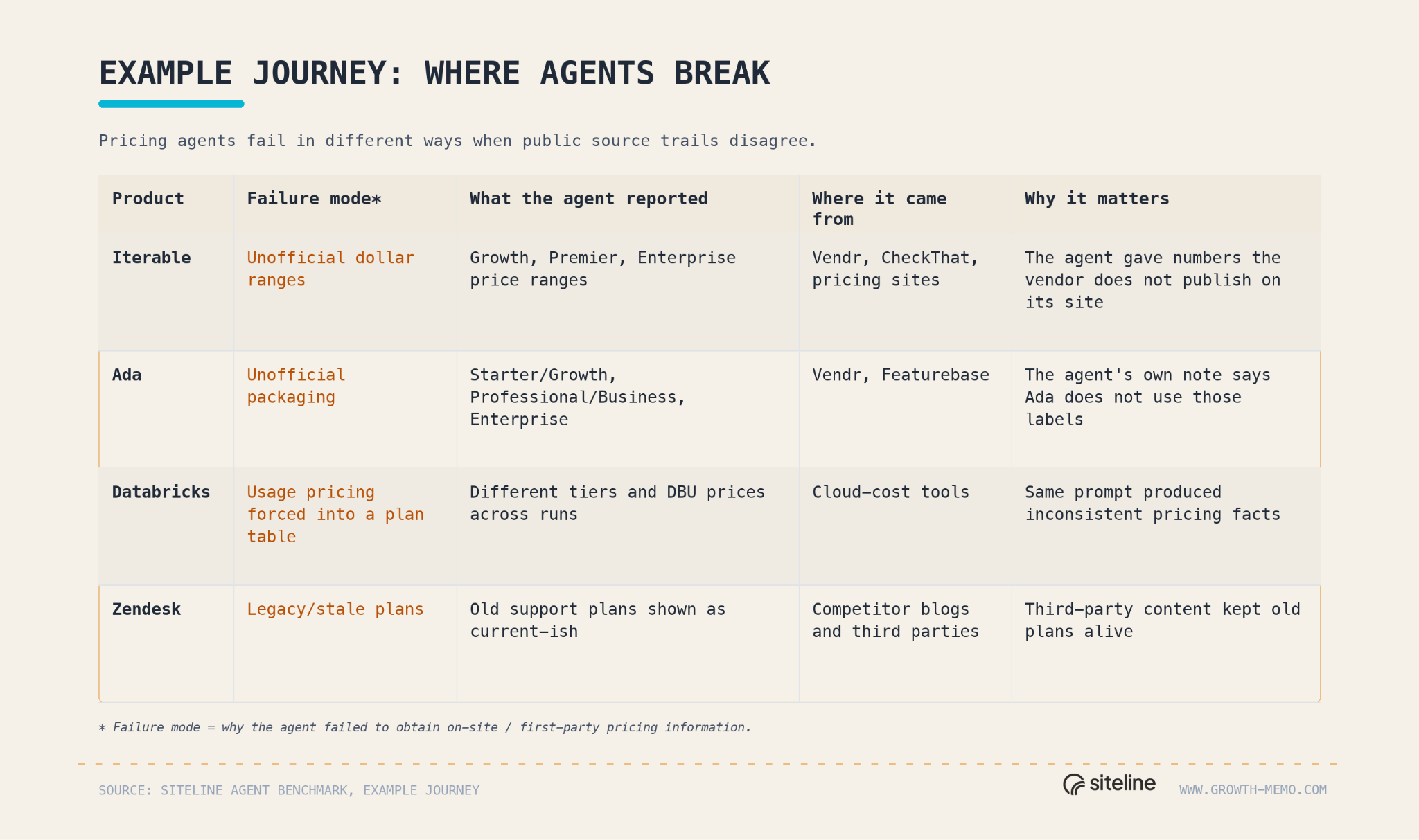
Right here, failure mode signifies the explanation the agent did not acquire on-site / first-party pricing data.
5. Methods to make your web site agent-proof
An agent-proof pricing web page is how you retain the agent quoting you rather than a listing like Vendr. The fixes map to the three failure modes.
Disclose the actual fact (opacity)
- Publish actual costs in textual content for each self-serve tier. If a tier is genuinely customized, say what drives the quantity as an alternative of “contact gross sales.”
- Maintain plan names, costs, limits, and options on one canonical pricing URL, and level each different point out again to it.
- Mark legacy plans clearly so third-party content material can’t preserve stale tiers alive.
Make the actual fact extractable (machine-readability)
- Put costs in crawlable HTML. Many agent fetches by no means run JavaScript, so a value rendered client-side is invisible. In testing, costs in server HTML acquired learn in below a second; a JavaScript-only value acquired missed.
- Add schema.org Product and Provide markup with value and priceCurrency. This single lever moved a web page from 73 to 93 within the readiness take a look at.
- Clarify usage-based pricing in textual content, not a calculator-only widget.
Let the agent in (entry friction)
- Permit AI crawlers in robots.txt (GPTBot, ClaudeBot, PerplexityBot, Google-Prolonged). Test you aren’t permitting Googlebot whereas blocking them.
- Don’t block server-side AI fetches on pricing pages. Entry errors hit solely 7% of runs, however they push fallback from 17% to 77% once they do.
- Maintain the worth early within the DOM and the web page gentle. A 1 MB pricing web page taxes each agent and pushes low cost runs to route round you.
Repair opacity and machine-readability first; they drive a lot of the fallback. Then run the question your self, “Discover all pricing and options for ,” and measure it with the talent under.
This submit first appeared on the writer’s web site and is republished right here with permission.
Contributing authors are invited to create content material for Search Engine Land and are chosen for his or her experience and contribution to the search group. Our contributors work below the oversight of the editorial staff and contributions are checked for high quality and relevance to our readers. Search Engine Land is owned by Semrush. Contributor was not requested to make any direct or oblique mentions of Semrush. The opinions they specific are their very own.
#brokers #caught #web site
